Tuesday, May 15, 2012

Crowd funding government.

Would you accept this deal?
Someone on a blog was talking of sacking all public servants.
It's the wrong strategy.

We need to make the public service work like the market. We have emerging tools. Block chain, Crowd sourcing and insurances can do 80-90% of what governments claim they are there to do.
Our public servant needs to be a true Public Entrepreneurs.
Tools need to be set up to make them such entrepreneurs. It's mostly just software as the links below show.
Try these examples.

The bridge needs fixing. A Public entrepreneur, Mr Bridger, has $10000 and the connections to get it done at $200000.
He offers the following deal on yourroad.org *
Pay $1 - $10 and get an internet thank-you note.
Pay $11-$100 and you get a sticker to put on your car.
Pay $101 and your name will be embossed on the handrail.
Pay $2000 and you get a table at the bridge opening dinner (max 20 seats be quick).
If $200000 is raised/pledged by November the money comes out of your account and the bridge will be repaired.
If under $200000 is raised by November your money will be refunded (or never collected from your account), You will still get the internet thank you note and Mr Bridger will pay you $5000/ the number of individual participants.
If more than $200000 is raised; its oversubscribed. Mr Bridger will take a 5% profit from the surplus, contribute half the remaining surplus to charity (named) and will find another bridge.
Needless to say the thank you note, sticker and embossed handrail all cost a fraction of the remaining $5000.

This is the most powerful crowd funding contract possible. If the 200000 is raised the bridge gets fixed. If not; those giving up their credit card details 'get their money back' with a tiny profit. The Public Entrepreneur only risks $5000 of his $10000. He may spend some of the rest on advertising in October if he's close.

The first actor problem is solved. Anyone contributing first risks nothing and may even profit if he is the only person tossing into the hat. Digital tracking makes the transactions on the site cheap treading to free. Frauds get dropped from the site. The cost is spread thinly over many people so the free rider feels little financial pressure but a little social pressure "Where's your sticker Bill?" With less than 50% paying tax the free riders are abundant today. With some of that tax being public service staff pay going around and around in the tax system the numbers are often much lower.

How would this finance a pension for a disabled person? These are the true undisputed poor not the lazy. This is medicaid, public health and the third rail of social security.


It's simple, Create an assurance contract for an eligible person, the money if raised goes to create a savings account (with a gold based inflation hedge if needed). Part of the interest is compounded part is paid out as weekly instalments. The biggest and best target would be about $500000. At 5% that would pay $235 week; 52 + 1 Christmas bonus. With half compounded until the trust's doubled. If there are exotic medical costs another round of fund-raising would buy extra medical insurance. This person is set for life and never needs to be a government problem ever again. This would work for veterans too. 


How would it do flood rescue? Buys equipment, train people, pays a very poor person to put his house up on stilts.
Can you create a private animal park and put tracking collars on lions? Their already being funded this way.

What would you not fund?
If you think the town drunks not worthy of your money would you throw a dollar in for the chance of the Public entrepreneur's $5000? 

Most known classes of public goods have been done. Police, parks, roads, medical research, hospital care, getting into university fully funded.
One girl from South America crowd funded a position in a top US UNI without knowing that she needed to meet other conditions besides just having the money but they waved the conditions. They wanted her crowd funding skills.

Public entrepreneur's replace bureaucracy, treasury and money bills in legislatures. It's a better deal than lobbying and paying off a politician so it may partly eliminate E street [The lobbyists in Washington. Every capital has it's equivalent. ] It replaces debt funding of the projects people genuinely need and want doing.

An Assurance Contract could fund a money bill in the legislature in a fraction of the time of the normal political process. Everything with the exception of law and defence could be crowd funded and we could Crowd fund equipment, insurances and research there too.

Is the freerider still riding free? Yes so are all non taxpayers today.
Are there positive externalities to others? Yes but so what if Joe from interstate gets to cross the bridge once a year!
Are there any externalities that can't be financed this way? I don't think so. We can only find out what can't be funded by trying. 

Are some projects too big? Yes but subdividing a project that is unworkable due to size into several smaller ones may succeed.


There may be a few cases where the money is raised but the task turns out to be impossible, beyond the organisers capability, or just silly. However this happens all the time with your tax dollars.

As long as it's as easy as posting on facebook, as simple as Kickstarter or indiegogo. It's mostly free digits until you hit the target. Then it will fly like this kickstarter project.

http://www.kickstarter.com/projects/597507018/pebble-e-paper-watch-for-iphone-and-android
Kickstarter is 'no dollars down' preorder capitalisation! {Business finance banks are toast.}

http://en.wikipedia.org/wiki/Assurance_contract


Bitcoin already includes provision for this level of crowdfunding. 
 https://en.bitcoin.it/wiki/Dominant_Assurance_Contracts

  * yourroad.org is not real, yet.

Sunday, May 06, 2012

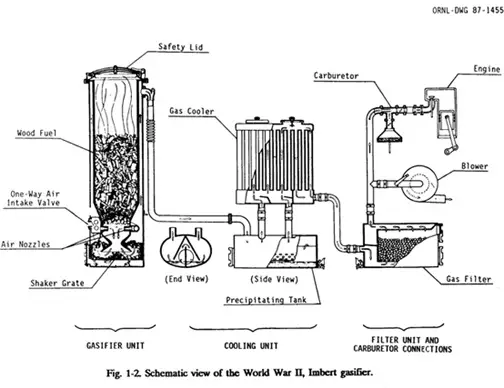
 Wood Gas Cars.

If Climate change were real and the IPCC were truly about saving the world then maybe they would grab something that works and make it better.

Wood gas works. Its old technology. Its zero carbon. Its free fuel in some cases, cheap fuel in the city. It can be improved.


http://www.driveonwood.com/

http://en.wikipedia.org/wiki/Wood_gas_generator

http://www.motherearthnews.com/Green-Transportation/1981-05-01/Wood-Gas-Truck.aspx

Its worked before: WW2
http://www.youtube.com/watch?v=9ycJE7KgO60

It works now: http://www.youtube.com/watch?v=rHjUJPeUh7A

Its loose in Australia: http://www.gasificationaustralia.com/

An old site: http://www.angelfire.com/ak5/energy21/woodfire.htm


There is a hundred video's on youtube alone.

So why is this an ignored solution? Why has it not been optimised using all the resources of government and a thousand universities?

The answer is when they say their pulling out all the stops, trying everything, doing whatever is possible! Their not quite lying but its close! They can't even know that they are wrong.

Governments try to pick winners but the process automatically excludes those that don't call for help or subsidies. This technology needs no subsidies. That makes them invisible to government. Also because those that are invisible to government compete with those getting the subsidies the solutions that work become blocked by the ones that don't quite work. We get technology that needs government help and subsidies and thus can never truly be THE Solution.

So how do you optimise and improve such a technology.


  1. Hybridise for city use: Add 40 km of lithium batteries, that's not expensive or heavy. Add all electric drive and regenerative breaking.
  2. Add an optimised 1/4 size gasifier and filter with a small motor optimized to charge as you go. Use an automated blow torch ignition system for the pyrolysis system and computer control. Design the car around the gasifier with a rear engine, gasifier and filter. A rear camera to eliminate the blind spot. Put a baggage compartment in the front.
  3. I would try a fluidised bed sand filter on the hot gases. In a fluidised bed filter gas flows up through sand. The hot sand catches and cracks tars and ash into light combustibles. The sand also flows and can be made to flow past a heat exchanger to dissipate heat. 
  4. Some WW2 models used water spray filters to wash and cool the gas. That also converts some of the carbon monoxide, the main fuel in wood gas, into hydrogen. 
  5. For optimal no fuss shop bought fuel. Pre pack the fuel in cylindrical pucks made of blocks cut to size and glued with proper spacing between two paper sheets with a sheet around the edge. Add a paper handle. Make each puck under 6 kg. At the petrol station converted to a multi-fuel depot add a raised platform, steps and a remote locked cage of fuel pucks.
  6. Invent a briquette machine that converts straw into pellets so it can run on grass in the plains and the savannah.
  7. I would also add a HHO system: an electrolysis cell making mixed oxygen and hydrogen. The hydrogen would bias the flame speed and timing back to normal allowing smaller engines.  CO burns slower that petrol; hydrogen burns faster than petrol. The two should balance. 

The first priority is the hybrid and the compact optimised power-plant. Everything else will follow as the technology optimises.


Less like this:


More like this: 


I don't think governments can do this. I don't think they can even see real solutions. What's best for the voters is not best for the bureaucrats. Solve a real problem and you kill off a bureaucrats job.

The Earth First greens will automatically oppose this. To them Wood means the evils of forestry. Sustainable human intervention in nature is inconceivable.  They will scream 'deforestation'! We must safe guard against that in some third world counties and government run forests, because they are the remaining commons on land. The "Tragedy of the commons" can only happen with government land, tribal lands and the seas. Private lands are not commons.

I don't think Anthropogenic Greenhouse effect is having any catastrophic effects on humanity or the biosphere. Change happens in all ecosystems and climate change is normal.

However if Peak Oil is real and solutions are needed. Wood gas as it is currently configured is a good fuel for those in naturally wooded country side. It can be free as the above sites show.


It requires skill; but so did all engines once.


It can provide stationary power.
 http://gasifier.wpengine.com/personal-energy-grid


http://www.motherearthnews.com/Renewable-Energy/1981-07-01/Mothers-Backyard-Homestead-Utility.aspx

Can this be used on every car and tractor in the world? No but this will work where electric vehicles fail. Optimised it will put a big dent in any energy shortage.

Here are some Swedes having a go in 1942. Full factory production.
http://www.youtube.com/watch?v=vGO5J9HMkGE
(If someone can do subtitles that would be nice. One American wood gas enthusiast caries a small electric chainsaw in his car. I bet these swedes wish they had one.)

Edit: Fixed the dead links.

Saturday, March 31, 2012

The Space station challenge.


Wesley Bruce
We need a radial world builder.
For decades now people have designed space stations for human habitation off the earth. The International Space Station is our first but while its nice zero g lab you would not want to live there.
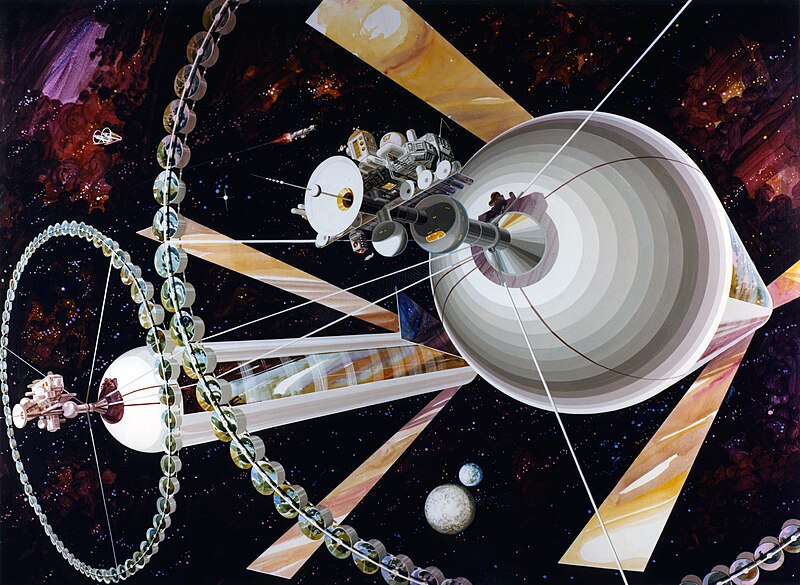
It's been known since 1920's that any truly habitable space-station has to be a big centrifuge built with materials predominantly mined from off the earth. The minimum viable radius is 80 m and the maximum revolutions per minute is 1.2 rpm. But most are much larger in size, something like this:

That's an O'Neill island 3. The design is from 1976. Each cylinder is: 5 miles (8.0 km) in diameter and 20 miles (32 km) long and with 3 valley's per cylinder that look like this:
The valleys combined yield a usable land area of 157 square miles and the small cylinder ringing the larger cylinders are 0.5 g farm units
We also have designs for torus's that look like this:


Hopefully many are aware of these designs.

There are good animated designs on Youtube but none that you can walk about in. http://www.youtube.com/watch?v=zBIQCm54dfY 
and
and

While these models and fly-through's are OK; building a world you can walk around in is difficult. Bungie managed it with Halo using a very smart skybox solution and we would need that in any space station design. However to create something that works well and gives the feeling that your really there we need to innovate. Something that makes people feel as if their in the future requires a dedicated physics engine and creative code to solve Level of Detail problems caused by angle.

To do a centrifugal space station the normal x,y,z parameters of a game physics engine are inadequate. It does not handle curvature well and gravity is locked in one direction causing endless code problems. Several people including myself have tried to do something in Second Life and have found it exasperating to say the least. While not totally fruitless, the work at Space Destinies in Scilands stresses Second Life's LSL code to the limits. (Sadly Space Destinies is gone from Second Life.) 

To really work well we need a physics engine that defines x as an axis, y as an angle around x in degrees, minutes and seconds, and z as a radius out from the axis x. In three dimensional space therefore x=0, y=0, z=0 needs to be defined in an more normal x',y',z' co-ordinate system so graphics engines don't have a fit and crash.
 We may use x, Ω and r for axis, angle and radius to avoid problems. However Ω is not a standard letter which may increase code size and decrease speed. I don't know if it will. 
My code writing proof reader tells me it will and we will need to stick to 'o' or something.
Care must be taken not to add the angles as non angle numbers. Because there is both a 3d coordinate system and a radial coordinate system it is possible to build several spinning stations in the one 3d space. Thus will require an additional parameter 'spin direction', clock wise or anticlockwise relative to x' = 0 y' = 0 or the sun.

Objects are placed at an x, y,z coordinate but with the object orientation in the z direction. At high z that is not a problem the surface is near enough to flat. To prevent edges from disappearing into other objects and overlapping textures jittering we may need to adjust the edges or come up with edges that fold down at an angle. I am a firm believer in giving virtual trees roots (no collision) that reach down into the ground so that you don't get the floating tree problem on slopes. 

Object rotation is a challenge because it adds an extra two bytes to record the angle or 4 bytes if the rotation is on two axies. The larger an object is the better in this respect. Using a single byte 1-255 and multiplying by 1.4 round nearest would work. Another solution is to sum the absolute value of the x,y,z coordinates into a seed angle and use that for random objects: flowers, trees, rocks. It may be possible to add a class of objects called key stones. These have orientation saved for them and all the adjacent objects in the non random classes calls the angle from the nearest key stone and assumes that orientation. Best for structural elements that are not the hull, walls or end caps but are buildings, roads, water flows, hedgerows. These may be treated as optional extras where other orientation options are established.

Gravity needs to be defined by three parameters. Parameter 'Inspin': is the location in the centrifuge or not. If 'Inspin' is yes then what's the locations rate of rotation 'RPM' and radius = r in meters. RPM constrains rotation to prevent dizziness. RPM over 1.2 is unusable for a general populous. Gravity due to centripetal force is a= v^2/ r. For r we can use z since its a radius.
G is 1 where v is 99 m/s for z = 1000m and RPM of 1. v = RPM/z
Very large space-stations 8 km radius can have RPM as low as 0.35 rpm. A v of 293 m/s
Note: Close to the axis gravity will diminish to zero because r [z] drops to zero. At the axis we have a potential divide by zero problem so if z is less than 10 inspin is 'No' to avoid the problem. 10 provides a buffer, 1 might not suffice.
and

If 'In spin' is No then the player or object is in zero g. Objects should not fall and players should fly. Even cattle should fly in zero g. [It may be a little stress full and ruin the milk!] flying speed should be near zero for anyone without a propulsion aid. That's why the International Space Station has few big empty spaces. Its possible to get stranded with no wall in reach and flapping your arms does not get you very far.

There are several other problems to be solved. As objects are built or placed in the habitat adjacent in the y angle they will converge in the centre x axis. For very tall objects this will produce acute angle collisions. If everything is rectilinear, or uses square bounding boxes, the code may crash. Some procedurally spawned triangular objects, gap fillers will help. Adding a minimum z limits on some objects solves this problem.
Space stations have end caps in the case of the spheres and cylinders and side walls and ceilings/windows in the case of the torus designs. Building these by hand is hard so a procedural method is required ideally at the new world creation phase.

In some cases the centrifuge is inside a larger pressurized hull. Sea of Suns SF and my banked track space station design. In this context we need another surface. One that represents a hull moving past you at 100 m/s. It needs a corresponding fast moving animation. Contact with this surface should be fatal without special tools. [I can see ways to do the special tools to jump on or off, in a real space station. I need an armoured suit with wheels on it and a powerful electro magnet. ]

LOD level of detail problems need to be dealt with because in a space station you can see other areas of the space station several miles away. Here is no horizon when your in a bottled city. 
 That's a horizonless New York downtown.
From http://berglondon.com/projects/hat/

For a closed world which is highly constrained this is just a skybox problem. For a true open world simulation this is a problem since you can see things due to the inside out nature of the world. Minecraft is one case that handles very high lod problems created by the ability to build very high, 255 in the current game. This means you can see many km away. Another solution is to edit the sky box on the fly to display a lower resolution image of the areas seen. This would be similar to the minecraft mapping resolution. We could use several options for longer distances including 2 to 6 pre-saved default texture maps, 9 chunks, per biome that are tiled to form the unexplored area. These would influence the higher resolution map when its crafted if the player ventures into that area. A last ultra long distance option is green, blue, brown and yellow surface fog.

Building blocks for the world need to include some large hull plates, rock sheets, soil over hull plates, and windows. Some stations have windows in the floor illuminating the valley opposite. Each would need flat, 2d curved and spherical geodesic. To minimise save file size and edge to edge fitting they need to be relativity large. Given the rules of space-station architecture they would be very robust. High but not infinite hit points.

The result would be a representation of these spaces station for educational purposes and for gaming. Because education is my primary short term goal the result needs to be reasonably realistic with procedural landscapes and some buildings. Because many interested in manned space colonization will want to place their stuff in our world it needs to be open I.E. Compatible to open source objects or objects from sketch up, Maya, blender, wings, etc.

If we want to build gaming worlds then appropriate foes would be a would-be dictator and his troops, terrorists, aliens, rebellious robots, or in the case of a space-station world that is very old; primitive humans armed with bows who barely believe in the existence of earth. Big Guns are likely to be banned in such a space  station. If your trying to take a space station intact you may want to limit you weapons to non lethal stunner's, dart pistols, gas grenades and bows. Some space stations may be populated with animal transplanted from earth. This may go beyond sheep and cattle to include dangerous endangered species and genetically modified creatures that they wont allow you to grow on the earth. That could go wrong badly particularly if someone takes violent offence at your killing their newly created GM pet dinosaur.

A suggested option list is possible. It is only included to ensure that the magnitude of the options purists will demand is fully appreciated early. [So you can chicken out now. lol.]
At the creation of a new world the player, world crafter, would be asked for:
Station type:
  • Sphere (Bernal sphere) has a main length of 1m to 100m. Radius over 400 m; optimal 1km. Most buildings are on the hemispherical end caps lower slopes. Generally its terraced.
  • A cylinder has a main length of 101m+, hemispherical end caps.
  • A torus has two parallel walls and an arched glass roof at the roof height. Torus wall height is half the roof height.
  • Banded torus (Crystal-palace) is multiple tori side by side with some of the side walls removed creating a very wide torus.
  • Dumbbell; A pair of balls on each end of a stick or string [Tether]. Often dome shaped habitats. Main length is a width of the dome and the circular base. rotational radius is the full length of the dumbbell. 
  • Beaded torus; The same as Dumbbell but with more domes. With 4 to 20 domes defining each section and some sections are not drawn if their not opposite another bead.
  • Bubble is zero g, air filled but has a narrow and low centrifuge somewhere inside generally on the equator. In this case most activities are zero g with the centrifuge taking the form of a subway train full of apartments, gyms, a school, etc. {This is my own design. http://bit.ly/BankedTrackGravity}
Material: Metal, asteroid rock, glass.
  • Metal is the default.
  • Asteroid rock is bumpy,
  • Glass is generally only used for bubble. Actually this is not just glass but may also be diamond sheet, reinforced polymer, transparent aluminium, biological material, or clear unobtainium.
Main radius. The radius of the main habitat floor. There may be rooms, basements, below this in some cases.
Main length. The length of a cylinder or the width of a torus. Also the diameter of a dome making up a dumbbell or beaded torus.
RPM.
Percentage urban: rural: mountain: wild.
  • Urban, buildings, concrete, some flat and sloping grassed areas, some trees.
  • Rural. Farm houses, Grass, woods, hedgerows, roads, and ponds.
  • Mountain. Large hollow buildings with earth roof and walls or sculpted cliffs. Some trees.
  • Wilderness. Lots of trees, smaller patches of grassed clearings and ponds. Some rivers.
Zero g radius and length. Some stations have large non spinning structures out side the end caps. These take 4 possible forms. This may also need a separate material option.
Zero g Habitat Type:
  • Large pressurised industrial voids.
  • Tunnel and rooms. All zero g with some unpressurised rooms and tunnels.
  • Zero g farm. Lots of floating trees, 3d vines and puff ball plants.
  • Mixed: all three.
    Airlocks define pressurised or vacuum. The vacuum is contagious spreading from room to room. The bubble space-station design can use this zero g architecture with no vacuum rooms (until someone does something stupid ).

Lights/ Windows:
  • Valley: The window is in the floor with a soil covered area opposite and adjacent. Normal in cylinders.
  • Mountain: A structure on the valley that has stone side walls and earth covered slopes and glass lens on top spreading the light across the opposite face. I.E. Rama's lights. They allow smaller windows and more living space.
  • End cap: Window above 60 degrees on each end cap. Normal for the Bernal sphere.
  • Axial light: a fusion lamp or solar light pipe running the length of the structure at zero radius. Used in all toruses and any of the others.
  • Sun clouds are small glowing drones.
Torus options number: 'TOB” between one and 20. Two body spin locks TOB to 2.
Torus roof hight.
  • The highest point of the glass roof. It's arch curvature is set by the ratio of this value and main length. In Banded torus its curvature uses 1/TOB x the main length. The arch repeats TOB times. In the beaded torus the main length is much greater than the roof hight. It also curves down to the circular wall. I.E. its a dome. TOB sets the number of completed beads.

This parameter list covers all the current space station designs including the ISS. It is only a suggestion and need not be done all at once.

It would be nice if we could simulate Coriolis forces with reasonable accuracy. Objects will not fall straight down they will fall in the opposite direction of the stations spin. Flying objects will veer in the same direction. Water will form complex eddy patterns even in slow flows.

I can see what is needed but I can't write the code. Dyslexia makes me a lousy programmer. I have done some programming training way back in the 1980's and know some more modern languages. I know how it works but I just don't have the speed and memory for it. I need to build a team. I have no starting funds so it needs to be an open source project or a component of a commercial game.

Wesley Bruce

Skype: wesley_ian_bruce


Monday, March 12, 2012

Space station fly throughs.

Space propulsion is progressing nicely as many new companies enter the field. Cost and complexity will diminish in the next few years until the price drops to the point where it will be cheap enough to build big space stations. That price is about $3000 a kg is the key target. Its currently $10000. Very few resources would be shipped from earth. The asteroids and the moon would be the main source of supplies.  However to build them we need to build on the success of the international space station that has been testing the material and other aspects of the science. A construction shack space station needs to be launched to do some heavy industry in space.
http://www.nss.org/settlement/ColoniesInSpace/colonies_chap07.html


Then we need to start shooting resources at it from mining robots on the moon and use an asteroid tug to drag a chunk of a near earth asteroid into orbit near the construction shack. A few supplies and fuel will be sent to the construction shack from earth as rockets that are cannibalised for resources.

WE wont live in little zero g habitants like the international space station. That's just a lab. Nor will we live in the construction shack for long. 
We will live in huge centrifuges kilometres in diameter that spin to produce gravity.

Once the large stations are built they become the base replacing the construction shack and becoming the home for thousands. There are enough resources for 700 billion people in the asteroid belt alone.  With these technology there are no limits to growth.

This is what they will look like on the inside and in some cases showing the out side.

Arthur C. Clarke's Rama a representation by Eric Bruneton;  10 km diameter, 30 km long.
Internal surface area including the sea and the full scale duplicate of Manhattan Island:  942 square kilometres.

http://www.youtube.com/watch?v=zBIQCm54dfY
This is how he built it.
http://www.youtube.com/watch?v=wKM2nDZ4rM4
The code is on his site: http://www-evasion.imag.fr/Membres/Eric.Bruneton/

Footage of the space station from 2001: A Space Odyssey.
 http://www.youtube.com/watch?v=egqeCn9JS4A&list=UUs-Iw8vN5cTJ_FzjzHLMggQ&index=2&feature=plcp

Bernal Sphere Space Habitat - Updated flyby.

http://www.youtube.com/watch?v=XLqfkZZQl5g

http://space.mike-combs.com/bernal2.jpg

see also  http://en.wikipedia.org/wiki/File:Bernal_Sphere_3.jpeg

This is Original larger sphere idea by Aubrey Bernal 1929 about 3-5  km 

  http://www.youtube.com/watch?v=OQP_7rJgBkk

This habitat is one of the smaller units with accommodation for only about  20,000 to 30,000 people. It's internal habitat space is 12 square km in the main sphere. The cylinders either side of the sphere are the Crystal Palace units: another 10 square kilometres of farms with 5 floors of factory space, livestock farms below that. The Crystal palace design without the Bernal sphere is a stand alone design and probably one of the first stations built.

 Island One, a modified Bernal sphere developed By Gerard K. O'Niell with a diameter of only 500m rotating at 1.9 RPM to produce a full Earth artificial gravity at the sphere's equator. Room for about 5000 people. 

One of the commonest designs is the O'niell Island three design.

http://en.wikipedia.org/wiki/Island_Three


http://upload.wikimedia.org/wikipedia/commons/9/94/Spacecolony3edit.jpeg
There is no good walk through. I'm going to try to fix that.
 
There are many larger  toroidal space stations. 
fragomatik is a prolific artist. I think his real name is Perry Papadopoulos. In Sydney.

http://www.youtube.com/watch?v=Wn-e5QlfJWA&list=UUOLio0oKOmtWiIlosl_YB1Q&index=2&feature=plcp

and

http://www.youtube.com/watch?v=9PYOgQEiBu4

and
http://www.youtube.com/watch?feature=endscreen&NR=1&v=oazFe2jbMxw

Hollow asteroids are another idea perry has explored.
http://www.youtube.com/watch?v=swMAjaQ5AsQ
This looks to be about 1 km on the out side but 5 on the inside. Minor details if the inner scale is right then its  78 to 125 Square km in internal surface area lit by a giant light pipe.

Uzi Berko's design is good too. Its toroidal, about a km wide and 20 km diameter, at a guess, 62 square km but with massive zero g volumes in that huge attached cylindrical structure. That could easily have another 4 or 5 500 m bernal sphere's or smaller toruses in side it. lighting appears to be artificial.


http://www.youtube.com/watch?v=qD3GMwg4qZo&context=C44e3ff5ADvjVQa1PpcFNTKvXvXmAWXY4eUAWqxvjdi2GHZ_7tFJA=


The biggest design is a Bishop ring. This is close to the scale of the halo in Bungie's computer game of that name. A bishop ring 1,000 km (620 mi) in radius and 500 km (310 mi) in width, containing 3 million square kilometres (1.2 million square miles) of living space. It would spin at 1000 m/s which is about 1.7 revolutions per hour. Very fast.
http://en.wikipedia.org/wiki/Bishop_Ring_%28habitat%29

The closet on the web is a ring world flyover. Larry Niven's Ring world is impossibly big. It is a ring wrapped around a sun. 

http://www.youtube.com/watch?v=j6Uc4Hlj2kQ&feature=related


Space stations will not look and feel like being on earth but then being in New York does not feel like being in the countryside of York England. Both have their functions. If you believe in limits to growth then the earth is already badly overpopulated but If you believe that we can make new environments then the options are limitless. Space stations will not just be for the people. there's no reason why the plants and animals can't be endangered species living in combination's not found on earth creating whole new ecosystems that would have never been seen other wise.

On a space station every thing is recycled even the air. Yes there are things that could go wrong but the same is true in any city. An accident on such a station is no more of a problem than a wild fire, a blizzard or a hurricane.
We will work it out.
We must look to the future. If we hope to turn around the world and get it on the right track it helps to have a destination.

Thursday, August 04, 2011

What would a world of balanced books, balanced budgets and small governments look like in 2050 if the tea party won world wide?

The prerequisite for this is a stable gold based competing currency system with private mints and media based testing and verification of the coins, notes and digital accounts.

Most 'government' activities would be converted to charities with out a change of address or staff. Projects would be listed on web pages with a donate now button. The money donated comes from a bank account for the purpose. This account is a small or micro account that earns no interest because its not a term deposit. These donations are logged at the account and are tax deductible. The account would be topped up after a cell phone alert. Mixed with the free services an express service to paying customers might be added in the case of some non essential services. Immediate care for later voluntarism; paying with your own hands has been used in the third world often as an out growth of refugee and missionary work. It may come to the first world. The similarity to a co-op or mutual aid society should be noted.

Agencies that waste money wont get may donations. Agencies that are deemed unconstitutional will only get donations from their supporters and employees; that may be enough to keep them going but not enough for expansion. The productive wont subsidise the unproductive. The beseechers wont be rewarded at the expense of the producers.Those in true need will get help.

Long term private bond systems selling either to the public or to vested interest groups would cover  long term infrastructure including transport, ports, public parks, recreational and the fixed assets of police, courts, defence, civil defence, etc. Donations, tolls, rents and other usage fees would be accumulated to cover the bonds final payout. The option remains to allow fee access in many cases where donations are sufficient. If they are not then there is an error in how the public asset is operating. Some entities already bill people via their cell phone. Similar systems for large public recreational facilities, parking, camping, etc would be normal.

In the case of some RFID based toll systems the first few rides are free on a section of road you have never been on. Provision would be made for drivers to donate tips to working road crews, where they see them, electronically without stopping. By 2050 many vehicles will be fully robotic with toll functions automated and invisible.

There would be no huge unfunded pension liabilities such as social security and Medicare. Almost all people would have their own pension funds and medical insurance which are fully portable: not just interstate or inter job but internationally as well as nationally, perhaps trans-planetary given that some may no longer be living on planet earth.

Those that lack incomes would still have pensions and health care via charities that pay the premiums. Unemployment insurance would be cheaper because with a gold based competitive currency system there would be no booms or busts just steady growth at a sensible rate.  There may be fewer jobs building houses that a housing boom affords but there will be no risk of a bust either.  There may be some miscalculations leading to short term large scale losses where technology change, sudden disaster or the end of a fad ruins plans.

3D printed goods, digital matter and other equivalent technology would be cheap and nanofabricators might be available. These lower the cost of living for all making lower wages and smaller pension payments go further than they did in the inflation prone 20th century.

At the time of writing, 2011, new medical technology is coming on stream including adult stem cell cures for arthritic disorders, bone density loss, skin elastin loss, and diabetes. These treatments are cheaper than the many years of pharmaceuticals and doctors visits that they require. Cancer experts think that most cancers will be easily treatable by 2050. Robot cars will reduce road trauma to a fraction of the current rates. This means that most major drivers of rising medical costs. Gene-therapy for many rarer but very expensive disorders are being funded by aging billionaires; a dollar spent there saves five in later hospitalisation.

Defence might be significantly smaller, particularly the US military. I think some of the bases will still be out there in the world and several countries will still have a global reach. New techniques and new technologies coupled with a greater defensive focus, much more civil defence and robotic warfare will contribute to the shrinking of armies. The adult stem cell advances are already being used to repair the ware and tare that force many older soldiers to retire. Most don't leave because of combat injuries but because of strained joints and tendons due to the fitness regimen they must maintain. The cure of this problem coupled with robots carrying the heavy stuff will mean the average soldier wont be a teen or twenty something but will be much older men and women with the experience of decades. This will change war like nothing before it.

Politicians would still exist but their function would mostly be confined to media like functions of oversight, and law making not handling trillions of dollars of someone else's money. Campaign donations may still exist but will be much lower because most will be also donating directly to the genuine needy and other causes.  The politician is just another middleman. The pork barrel would be almost empty and those that want a free lunch at the governments expense would find life harder.

Sunday, June 05, 2011

Minecraft fun

I've mapped hoboland [probationary player area] on the wrxds server. Mine craft has a in game mapping systyem that allows you to make a map object and use it to map the world. You must wander around with the thing in your hand to get the map made. Given that the game has zombies, cliffs, deep holes, traps and lava ponds that can get interesting at times.

Tuesday, April 19, 2011

Human rights for mother earth?

 Some want to grant mother earth human rights.
http://www.foxnews.com/world/2011/04/18/prepares-debate-rights-mother-earth/
Defining what is needed to sustain the earth and humanity at the same time is easy? 
  • Avoid extinction of properly defined species by allowing ownership and breeding. Farming endangered species if needed, keeping them as pets if possible, and creating seed banks and private parks.
    • Develop tools to increase the efficiency, productivity and intensity of some natural resource systems so that others can be rested allowing recovery. Intensive crops and hydroponics replacing unproductive peasant farming.
      • Develop industries that buy degraded systems, speed its recovery and sell at a profit the improved land or resource. Private parks and Permaculture. [Only in a government monopoly can land become so degraded that it can't be restored. Love Canal was an official government and army waste dump before Hooker Chemical were given federal orders to dump there. "The corporation refused to sell, citing safety concerns, and took members of the school board to the canal and drilled several bore holes to demonstrate that there were toxic chemicals below the surface." Wiki Sale of the site]
      • Where viable recycle; where that's not viable, store waste in safe land fill for later mining and recycling. The first profitable landfill mine was in Israel in the 1950's. There are hundreds today.
      • Develop a diversity of energy technologies, using fossil fuel to increase the wealth of society and buy time while other energy technologies are matured to cover base load energy and transport.
      • Rule no technology out unless it proves truly and indisputably unsafe and uninsurable.
      • Farm the seas don't just hunt them blindly. Fertilise, sow and reap for maximised yields. Farmers must own their area of the sea.
      • Finally, remember that there are 3 other terrestrial planets, 80 moons and 1 billion asteroids in this solar system. All have resources. 
      We already have a name for the key tool that allows all of this, its called 'capitalism and private property rights'.
      If property rights are allocated properly then it has the same effect as granting rights to the earth itself because in the free market no land or resources has a zero value. When you declare something priceless and strip away property rights you make it worthless and put maintenance in the hands of disinterested bureaucrats who can easily drop the ball and become more concerned about the size of their desk than the species they protect.

      Friday, April 08, 2011

      If climate change was real and effected agriculture

      Assuming it was not based on flawed data, fraudulent scientific papers and exaggerated media claims used in UN documents. Assuming the world was warming and that changed growing patterns world wide, what would we do?
      1. We would need to retrain millions of farmers. Formal training for farmers, not agronomists, ordinary farmers, is needed anyway. Over 60% of Australian farmers are past retirement age. We need to train people to replace them anyway. Farming is not for amateurs. 80% of the third worlds farmers need training too regardless of climate change. Private, web or magazine based teaching is the cheapest option for agricultural extension with some investment in vehicle mobile teaching tools in remote areas. 
      2. As seasonal patterns shift farmers will need to change their choice of seed stock and crop variety. Seed company's have ample diversity in different seed stocks for wetter, drier, colder and hotter growing conditions. 
      3. Some farmers will need multiple on farm seed storage for several varieties so they can buy cheap, store long, sow what they need in rush without running fowl of a scramble for seed stocks and rising prices when it apparent that they will need a given seed type.
      4. We need to plant wind brakes, hedges and grass hedges [Lev 19:9]. These block hot and cold wind, flows of frost carrying cold air and by stilling the air over the field it reduces evaporative water loss. It can with good design modify the temperature back to the pre-greenhouse temperature where desired. If fodder, fruit or nut yielding trees are used they are an investment with a quicker return than wood. Such plantings should be tax deductible and should be depreciated as machinery is.
      5. When greenhouse models predicted increases in rain fall the IPCC painted it as bad by calling it Increased rainfall variability and talking about flash floods. That sounds bad but by simply adding artificial bends and meander in streams, overflow channels and ponds we can catch these rains. 
      6. At the smaller scale swales* or ploughing with a Yeomans** aerating plough make the water move into the ground rather than running off. The key is to hold the water on the land long enough to allow the water to move into the water table where it moves very slowly and feeds springs that run deep into the dry years. The most extreme but effective means of doing this is terracing. Even with all our modern technology we do much less terracing of farm land than our bronze-age ancestors did. why?
      7. Where increased drought is predicted we need cisterns. Covered water storage and underground canals. Ancient man could build these in the stone age. Can't we do better? Developing ways to make them cheap and easy to build should make you rich.
      8. Also in deserts we need to move to more drought tolerant crops with drip and underground porous pipe based irrigation. This makes the desert bloom. This means a shift from water hungry crops to things like dates, olives and fruiting cacti but moving from one mono-culture to another leaves you vulnerable. Mixing up different species and value adding removes the vulnerability to fickle market fluctuations. The boab tree seedling is the latest new desert cultivar. http://www.boabsinthekimberley.com.au/
      9. We are the first generation that don't move livestock away from drought enough. We also need to be ready and equipped to move livestock away from flood zones early. Using farmer to farmer agreements as a form of insurance and looking at transport and agistment for livestock as part of a drought insurance process. While individual regions are drought stricken often there is another accessible region that is not. If done well it could be cheaper than current government drought assistance. 
      10. We need to give our gazing land time to grow high and put down roots deep restoring soil carbon. This drought proofs and flood proofs farms. If we allow the animals to graze land too sparely they bite back the recovery growth and the grasses can't grow strong and deep, they have no energy. There is a solution Holistic Management created by Allan Savory and Jody Butterfield. http://holisticmanagement.org/
      11. Where floods are an increased risk we need to make hills creating high ground where there was none, so people and livestock can get above the torrent. About half the farms have the necessary equipment. The channels we dig to get the earth will catch flood sediment and retain water long after the flood is gone remaining green as the rest of the land browns.  
      12. We need to domesticate many new species. Why fear flood if you livestock is Hippopotamus or Capybara. Why fear drought if your farming a drought tolerant native desert grass or the boab. We are domesticating two new species a month world wide. If we farm endangered species, e.g. the American buffalo, we find that their population recovers. Why not farm seals for the skin and meat? Why not keep a hairy nosed wombat on your farm as a wild pet? Numbats and monkeys are good eating I'm told. Properly farmed they could feed millions.
      13. In the most extreme cases of weather based disruption we will need to build greenhouses and hydroponics. These are getting cheaper by the year and are far cheaper than replacing our energy infrastructure. They can be fully climate controlled. Climate change is irrelevant; They would work on Mars and even Venus. The air can be cooled with solar powered air-conditioning, heated with solar thermal and all water can be in theory retrieved and recycled by solar powered dehumidifiers. In practise it might be cheaper to deal with transpiration losses by hauling in water by rail or even truck. 
      14. We may need to develop radical new technologies: Machines that convert cellulose to starch, algae farms to supplement livestock feed supplies. These too can be air and water tight, recycling everything if needed to be. Even Food nano-fabricators are not in theory impossible there are people working on them today.
      All these things are doable, some may not be cheap but a little more inovation could make them as cheap as modern computer chips. Remember when a cheap computer cost a million dollars?
      Most of these things will need to be done anyway. If the government tries to do them it will never have enough money. Only by tapping the tools of the free market and developing new tools to capitalise individual farms and farmers (education and agricultural extension) will we succeed.
      World population is growing; Food production has always grown to match. The climate is always changing we need to be ready for anything. We have the tools and techniques its not impossible to adapt to anything.


      *If you don't understand any term feed it into wikipedia.
      ** Water For Every Farm. Using the Keyline plan. By P.A.Yeomans.  http://www.keyline.com.au/   also uses swales.
      Australians Bill Mollison and David Holmgren developed some of these ideas into Permaculture. I recommend a Permaculture course. I've done one. Find a teacher that's greenhouse neutral, there are a few.

      Thursday, March 24, 2011

      If sea level rise was real and became a problem

      If the worst case scenarios for sea level rise come true and we get between 30 cm and/or 9 metres of sea level rise in 100 years, what's the worst that could happen?
      • We would need to rebuild our coastal resorts. We do that anyway about every 60 years. They are not built to last and go out of style soon after their paid off. If its profitable no government funds are needed. If its not profitable blow it up and make a park.
      • We would have to jack up or move a few hundred historic buildings. At five million each that's a few billion and half that will be millionaires 'moving house'. 
      • Some low lying towns will need to dig a hole and build a hill in or next to town. If they are smart all new structures will be multi-story and will be built on that hill or will be connected to it with a bridge at 3 to 9 meters above sea level. Turn the hole into a nice lake and put floating houses on it. Most towns already own the needed earth moving equipment. In 100 years you can heap up a lot of dirt. (I do not trust dykes and levee banks, too many have failed, why make them when for the same cost you can raise the town.)  If you loose crops in a flood then you were growing the wrong crops in the first place. Grow something you can harvest before the flood season. 
      • We need to farm coral in the pacific to make more sand fill to adjust the hight and shape of about 300 atolls. The coral will grow up to match sea level rise but there will be lags and cases where the natural process messes up the real-estate values- atolls move about; real-estate boundaries don't (they could and should on atolls but don't now). 
      • We would need to "build up" on those islands and out over the lagoon or the open sea with floating factories, malls and apartments. Most of the low islands of the Pacific, Caribbean and Indian ocean are under developed and needs reconstruction anyway. Those Island nations own millions of hectares of sea bed with minerals; They only think their poor. If its profitable government need not interfere.
      • Some coastal farms will need to switch to growing salt tolerant crops or fish. We already have a salt water irrigated grain:  Palmer's grass ( Distichlis palmeri ) A biofuel crop: Salicornia bigelovii and a sugar crop: Nypa fruticans.(mangrove palm) There are many other halophytes, salt tolerant plants, being developed as crops.
      • Some third world estuarine systems will need to be redesigned and rebuilt with all of the above measures. However since they are third world countries they need the development anyway. If they can't discover (or refuse to accept) the tools of modern democracy, development and capitalism then they will stave long before the sea rises to get them.
      That's it! A few trillion dollars of free enterprise and profitable development or redevelopment that would have happened anyway. The occasional million dollar community investment in the form of donations to educational institutions and heritage foundations so they can re-educate builders and farmers and move the odd historic building. It need not be done at all with taxpayer funds.

      Sea level rise is much slower than a tsunami. While the latter is horrendous; even the elderly in some cases outran the Japanese 2011 tsunami. Whole cities can outrun sea level rise!

      Tuesday, March 22, 2011

      Earth Hour advocates miss grid storage

      Those that push Earth Hour fail to acknowledge that without backup systems or candles, both mostly fossil fuel technologies, solar fails in winter, particularly if there's snow.
      I'm trained in that field: Energy storage is the critical tool we need to make grid solar and wind work. According to calculations grid storage needs to be 16 to 18% depending on whether it snows and how much biofueled grid power is available as a backup tool.
      We have the technology.
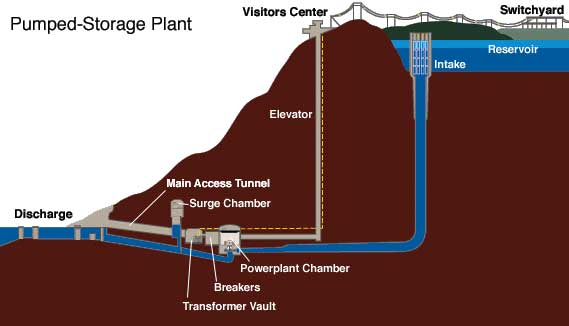
      Pumped storage between dams (or cisterns) of different hight is 90% efficient but the greens wont allow more dams.
      http://en.wikipedia.org/wiki/Pumped-storage_hydroelectricity

       Its particularly effective if wind and solar drive water pumps directly since both are more efficient at pumping at low wind and on dim days.
      Hydrogen is a viable technology too if your not trying to make it for transport. Hydrogen electrolysis is 80% efficient. The inefficiency often cited occurs where your then liquefying the gas, that's very inefficient.
      If you store the gas in a simple 18th century gasometer it would be cheap and sustainable grid storage particularly if the hydrogen is plumbed into a conventional coal fired power station.
      Yet no government has backed such a simple technology and the greens might oppose the gasometer's.

      Compressed air storage is also viable, 2 working plants at the large scale and several at the micro/ house hold scale,  but because its 130 year old technology you can't get a patent and capital markets are not interested if the solution is not exclusive. To do 10000 compressed air systems you need at least 100 companies.

      Exclusivity is the problem. World War one destroyed exclusivity in the fossil fuel game; we ended up with hundreds of companies in the game beaching each others patents willy nilly.

      When governments say their trying everything please remember its always a lie.

      In order to make this viable you also need a price differential between the makers of energy and the price of energy at the house hold or factory meter.  There needs to be a peak and off peak differential at the energy producer not the energy consumer. This margin allows the grid storage companies to buy low and sell higher into the peak demand. If renewables are paid the same price per watt regardless of their reliability there is no margin for the grid storage companies. They can't capitalise the needed technology. If Solar is subsidised without consideration for demand patterns and the need for grid storage the result is a negative margin blocking grid storage altogether.

      Some in the renewable industries reject base load energy  and the need to match generation to demand patterns. Yes it is possible to change demand patterns a little but these things are often locked into how all societies work. No society has been able to change them significantly. If grid storage is properly priced into a grid then there is less profit for intermittent energy producers like solar. However without grid storage these energy technologies are not viable beyond 6% of grid capacity.
      Generally grid storage should make renewables viable and reliable and therefore profitable. It should be profitable. If allowed, not encouraged just allowed, it should make a solar wind system viable as a response to real or perceived energy scarcity.

      Friday, February 04, 2011

      Torture is never simple.

      Why do we believe the claims of torture and oppression on the part of Mubarak's regime? The same people claim Israel, America and even Australia tortures Moslem. We know that's not true in our case, Australia, so why believe it in the other cases. Mosab Hassan Yousef in his book Son of Hamas showed that half of the torture in Israeli prisons is from scared Jewish conscripts and half is Palestinian on Palestinian abuse in search of Israeli informants or because some prisoner is not in the right faction. Is it the same in Egypt? In the Palestinian case the prisoners tortured by other prisoners invariable protect themselves and their families by blaming the Israeli government for the scars and missing fingernails.

      In vietnam the vietcong infiltrated the south vietnamese police, military and interlegence services. Some of the most fanatical and ruthless members of the south vietnamese forces turned out to be north vietnamese deep cover agents. To be ruthless in the name of the state you've infiltrated is a powerful propaganda tool. It allows you to expand attacks onto neutral targets.

      http://en.wikipedia.org/wiki/Phan_Th%E1%BB%8B_Kim_Ph%C3%BAc
       The wikipedia give the official cover story of the time. Blaming the pilots.
            You know that this image did more to win the war for the North Vietnamese than any other. What you did not know in the 1970's that it was a strike with napalm by South Vietnamese air crews on a civilian villagers and south Vietnamese troops well inside South Vietnamese lines and that it was caused by a North Vietnamese double agent who is believed to have switched the target coordinates and confined the target when the pilots were doubtful. The officer is now retired on a North Vietnamese army pension.

      How much of this sort of thing is going on in Egypt. How many of the Egyptian police and military are Moslem Brotherhood deep cover agents.

      Mubarak may be a despot but if he was as ruthless as they claim I would have expected Tahrir square to be knee deep in bodies by now; thousands dead in minutes. We don't see this! We see Mubarak moderating his actions at least in front of the camera. He is doing what many governments in the west would do, have done, in such emergencies. Muddled and botched attempts at law and order in the face of chaos. Not much different from Katrina or the French response to Moslem riots in the outer suburbs of Paris. We have only 6 officially dead and 900 wounded. We don't know what proportion of those are Mubarak supporters. We see the left wing anti-mubarak media under attack from Mubarak supporters. However would these western reporters be able to tell if they are being attacked by Mubarak supporters or moslem brotherhood fanatics playing both sides. Its only the translators words they understand.

      Remember the tea party marches in Washington, the few left wing reporters that bothered to show up made similar claims of pushing and shoving. Some of that was true.

      I think Mubarak should, and will, go soon. I don't think democracy will result. The world, particularly the western media are overdosing on naivety. The so called secular moderates that started this battle are no longer in control. Their hit and run protests of the first few days replaced with a very old fashion massive last stand in a public square. A very Islamic last stand at that starting with prayers. 
      An islamist dictator will arise, perhaps with a sham democracy as cover for a while. Remember Hitler was elected in a democracy.

      Thursday, November 04, 2010

      A post Federal Reserve Bank World

      The worlds banking system is in crisis. The Keynesian paradigm of fiat money and fractional reserve banking is dying. It has always failed but this time its smoke and mirrors tricks have failed to. They have printed too much money and broken the system.
      If they end the FED then what do we do?
      What does a post FED world look like. 


      The key to an alternative is two conditions. 1. Open entry, anyone can make money but no one is obligated to accept it. and 2. Enforcement of contracts, no one can make false claims about or fraudulent valuations of their money. I might add a third: Public and media based testing and checking of these money's and contracts.
      Assuming other central banks are also eliminated in the process.

      1. Gold and silver currencies in many competing forms:
      a. Gold backed electronic money for large and web transactions,This can now be done with bitcoin and ripple systems.
      b. Gram weight metal in plastic cases that work like coins or credit cards I.E. Shire Silver,
      c. Ounce weight metal barter coins,
      d. Nickel and copper coins with a contractual valuation in gold or silver. Not both.
      e. Large Dollar silver coins with a contractual value in silver and a embedded computer and screen that lists the current gold /silver value ratio.
      In most places one currency with predominate with machines accepting other currencies and giving the local favoured currency.

      2. Full reserve* banks with fewer offices but more digital and video phone to real staff interfaces. Several types of savings:
      a. Target savings accounts. Money is not available on demand until the target is achieved. (I remember these from my youth.)
      b. Term deposits with two days notice to withdraw. Mostly invested in mortgages and commercial loans.
      c. Direct bond sales via the banks interface (computer, phone or auto-teller) with a receipt. These bonds do not pay annually, they are true bonds. This avoids borrowing short to cover long liabilities. You know for sure you have the bond. Bank holds the bond until you request it.
      d. Credit and debit cards with small fees, higher but sustainable interest on the credit, none on the debit and higher default fees.
      * It is possible to have contract based fractional reserve banks but these would need to recall and extinguish their note and contracts each time they lower their reserve provisions. These would be much higher risk but fee free.

      3. Many more mutual funds. Operating as above.

      4. Automatic digital transfer of remaining accounts from failed banks to other banks that the first bank must pre-nominate and contract with. Any remaining assets are transferred with the accounts. This eliminates bank runs and is largely the norm today but the accounts go to the biggest 5 creating the to big to fail problem. The system needs to spread transferred accounts more widely. The banks share holders take a full remaining loss. That'll teach them to avoid real-estate and other bubbles.

      5. More peer to peer lending with legislation ensuring that the contracts are clear with no fine print. Defaulters get banned and get a poor rating that goes global across networks. This is unsecured lending but as the mortgage derivative debacle taught us, Banks don't always adequately secure the loans.

      6. A law change so that companies can sell shares and micro shares via a web application or digital broker on their web site with another site handling resale's. No minimum limit on the size of a share sale thanks to digital tracking. The current limits, minimum share issues and brokerage practices are tied to out of date methods and paperwork systems.

      7. Microshares are for very small web businesses with valuations in the fractions of a cent or via a virtual currency like SL Linden. Essentially the micro-transactions that were promised in the dot Com boom but got blocked by government meddling. Hence the bust.

      8. Many charities will use targeted fund-raising with things like Indiegogo, Kickstarter and other crowd funding agencies. Assurance contracts and particularly Dominant Assurance Contracts can fund most public goods and could subsidise access for the genuine needy to private user-pays goods and services.

      9. Law changes so some charities will sell bonds. The interest on the bond goes to the charity with the Donor retaining the ownership of the principle. He/she may choose to donate the principle fully to the charity after a time. This creates a permanent predictable interest based income for the charity to match on going needs and avoid fluctuations in donations. (Note: Not all charities today can invest donations long term. They must spend as they go; creating short term cash flow problems and thus a long term stability problem.)

      Some of these solutions were not available before 1914 and therefore we can't talk of going back. New technologies eliminate some of the excuses for fractional reserve banking and fiat currency. They don't eliminate the bankers desire for a cartel that blocks out new players or gets government to cover their losses but it makes it harder if we take away their excuses.
      It also wont eliminate the governments desire to spend beyond their means but again it eliminates the currency excuses. The new charity solutions and crowd funded public goods further reduce the need for government services which is why I list them.

      Interest rates would be higher, Rarely going below 6%, Mortgages would match this limit. Some long term interest would be 3%. Most shops would have tools to check coins and web linked digital signs to up date everyone on the current ratio of the available currencies. Currency values would be stable overtime and productivity would be high 5 - 8 % but not spectacular. Spectacular GDP is be mostly fake where encountered. The exception would be rapidly developing new third world communities and space colonies.

      It will be a very different world where we learn to judge money as a product and check its price and exchange rate as we go. Most shops will have tools help people in the transition. Your money will be safer than it is today allowing peoples plan to be fulfilled and not confused by government meddling.

      Thursday, October 28, 2010

      Building the first generation of buildings on Mars.

      The initial exploration of Mars will be in Mars habitats sent from the earth.

      An early mars hab. Mars society. 
      Search mar hab for more. 
      However there would in all likelyhood only be four or five such missions. Once a good site is found with the prerequisites for colonisation a real base would be built from mostly Martian materials. Those prerequisites are a deposit of water ice or underground water, Iron or Aluminium ore, good rock for building or aggregate production and some nitrates.

      Then an industrial module or two with the capacity to make structural materials would be sent to the colony site. Carbon fibre and carbon composites may prove cheaper and easier that metals. Carbon dioxide provides abundant carbon. Plastics can be made from CO2. 

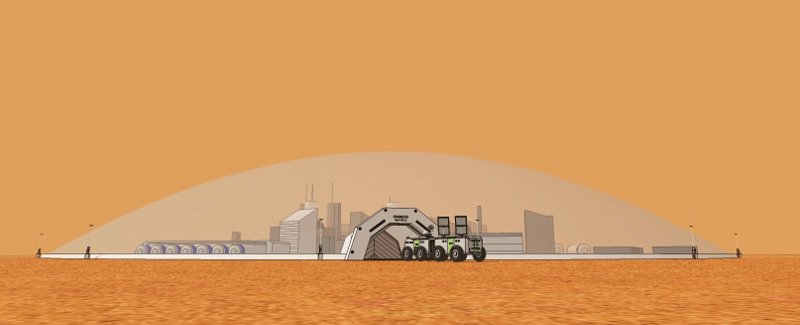
      So the question is what structure to build? Most think domes but domes have their disadvantages.

      Image from http://orig08.deviantart.net/cbf0/f/2010/176/b/4/mars_dome_01_by_ludo38.jpg
      Domes have lots of round corners that boxy furniture and things don't fit into, Its hard to stack radiation shielding in a dome and you need some shielding to shut out the natural cosmic ray flux on mars. 

      There is another little known problem: While Mars is cold the structure will have a lot of heat sources inside it so there will be a heat dissipation problem. Domes are good at keeping heat in due to their low surface area to volume ratio. A box is good for getting rid of that heat without expensive equipment. It has more surface and one face is always in shade.

      I believe the best early first generation buildings will be multi-story box like structures. Like this:
      This structure has several advantages. Most surfaces are rectilinear so replacing panels and windows is easy. There are ample windows for natural Martian light to enter. There are views of the farm domes and the landscape beyond. Reducing any claustrophobia risks.  
      The Martian radiation flux is cosmic rays so its a vertical flux. As a consequence only the roof needs to be shielded. If you make the building multi-story then one square meter of shielding shelters many square meters of living space. The shielding would be just rock or gravel, ~2-3 tons per square meter of roof. Far more than most domes could handle. The main structure would be reinforced concrete or reinforces polymer bonded aggregate with carbon fibre or iron reinforcing.
      This structure has several other features.
      Viewed from above you can see that the buildings stand on a central base,or shared ground floor, that allows shirt sleeves access from section to section. The buildings are segregated so if there is any pressure breach or fire in any building people can escape to the other sections. Behind the building are several tanks for spare oxygen and other chemicals that are kept clear of the main structure for safety and temperature control. The greenhouses are less shielded because plants are less vulnerable to this radiation.

      If you really like domes you can add them;


      You could even add playing fields etc in them:

      In the above structure we have a playing field. Short exposures to the cosmic ray flux is safe; it happens to you every time you fly on the earth. This sports dome doubles as a place to stitch together large plastic pressure structures. The brown boxes in the fore ground are chemical and heavy industrial plant units segregated from the main structure for safety reasons. To the side you have a mine and on the left in the distance you have the spaceport with its big white fuel tanks.

      This Mars base has several kinds of farming. The university dome in the fore ground has planters and grasses on any available area to feed people and animals. This includes planting on the roof tops. Most activities are indoors within the buildings. The elliptical domes hold fields for grains, pulses and vegetables. There is a multi-story vertical farm behind the university with hydroponic and airponic fruit and vegetables. Most people and some livestock live in the three remaining tall buildings. Some things will be boringly the same as on earth; there is a cell phone tower on the ridge behind the buildings.

      These structures would be built unpressurised. With pressure tight balloon like structures added to each floor and pressurised double glazed widows added to the out side. This gives the structures emergency redundancy. Essentially a plastic balloon in a box with internal panelling protecting the pressure balloon from knocks and wear and an outer shell to keep the sharp Martian dust away. 


      Eventually another technology will be used where suitable. These are low world houses. Roofed valleys with normal looking farms and suburbs. That however is many decades away. 

      I've written on low world houses here:

      It may be possible to terraform Mars but these technologies will make it habitable without much fuss.
      Most of my illustrations are done partly in Second Life and worked up in gimp. Some were on display within Second Life but sadly that Space Destiny's sim is now gone.

      Wednesday, October 27, 2010

      Banked track Magnetic levitation based artificial gravity

      We can make space station that simulate the earth's gravity using centrifugal force. Generally for maximum comfort the centrifuge needs to be limited to 1 RPM and that leads to a diameter of about a mile (1.6 km). These are thus very big structures with a lot of material mass. OK in the zero gravity of space but you can't stand one on end on the moon.

      Image: http://en.wikipedia.org/wiki/File:Spacecolony1.jpg
      There is a way to put a centrifuge on the moon or an asteroid. This is to use basic railway technology to create centrifugal gravity. The centrifuge is a train with multiple carriages running around a track 1.6 km in diameter and as close to perfectly circular as possible. Either the track is banked or the carriages are built at an angle so that the centrifugal forces combine with the low gravity of the moon or planetoid to produce approximately one g.
      The blue is the track with a large dome adjacent to it for low gravity recreation and some food and oxygen production. The Dome is stadium sized.

      Each carriage would be as spacious as a large train carriage. Some would be gyms for maintaining muscle tone and bone density by exercising in normal earth gravity. Some would be medical and maternity facilities to ensure normal recovery and normal pregnancies. Some would have apartments and hotel suites. In a well established base there may even be livestock stabled in some carriages.

      Luna 7 Tracked centrifuge and ancillary buildings and domes. Most structures are deep underground in the lava tube network. 

      Unlike a larger space station the train stops regularly to allow people to come and go. Warnings are given so none are caught out. Many internal structures are designed with a radical change of orientation. The direction of down changes through 60-90 degrees.
      To generate one earth gravity the train must run at 239 kph an easy speed for magnetic levitation technology in vacuum or a thin atmosphere. Stopping and starting takes several minutes so there is time to find all the loose things lying around that may fall.
      This small pioneer carriage is designed for the starting crew. Its orientation goes from this normal running orientation above to:
           
      This orientation when stopped. There is a possibility that the table and counter top might tilt. This model was in Second Life. The crew sit in a lounge near the table not on the blue seats. there is provision for standing at odd angles in the shower behind the floral screen, in the toilet opposite and beside the camera (Note: in the top hab image you see a grey/ white deck with the writing on it and the green box. I'm standing on the box in the second image. Select the box and stand ).
      The counter top has a kitchen bowl that is clam shell shaped. Thus it retains the water regardless of orientation. A spar bath in the gym would be the same only much larger.

      The first unit on the moon however would be small as the second life representation of a small habitat shows. It has three bunks, a tread mill for muscle and bone fitness and would be on an above ground track. A separate solar flare shelter would be near the track or one section of the track would be covered.
      A full sized flat car would look more like a luxury railway car.
       
      Image made with gimp from google images of search "railway luxury carriage"
      Larger cars or carriages are possible. Below are two 6 story cars with the external shell removed from the front one.  This has a garden with trees and a 4 story building. It has two connectors front and back. One for people [blue] and one for freight and through traffic [red]. The shell would be pressure tight with artificial lighting and view illusions, Trompe-l'œil, probably digital and changeable. These could be farms or offices instead of homes. [Track not shown.]
      These larger cars would not stop normally. Passenger transfer is by smaller cars running parallel on a track beside or under the main track.
       Zero g.
      This technology is not just useful on the moon. There it allows large long term human population to live normally. The technology could be used on asteroids. There the gravity is so low that you don't need spare floors at strange angles. As the train slows down to a stop the gravity drops to zero. Your wash basin needs a lid not just a funny shape.
      On this Asteroid we have two magnetic levitation train lines, yellow rings, as well as some domes for zero g gardening and several cylindrical building for zero g recreation and manufacturing, etc. the Black structure on the back of the asteroid is a solar furnace for power and metals smelting. The green domes are lit by free floating mirrors behind the camera. This asteroid could support 10000 people.

      I've also designed a free flying space station. This has the lowest mass to crew ratio of any design with centrifugal gravity.
      The twin trains run in opposite directions within the yellow ring. This is shielded with water tanks, storage spaces and space slag. The Sphere has a double geodesic shell with water in the gap for shielding and thermal control. The internal spheres are farms with shielded stowage for zero g planters. The geodesic spheres entire volume is pressurised as a large zero g recreational habitat.

      The large dark thing on the right is a solar shield. This reflects the suns radiation away, provides some radiation shielding and a safe place for ships to dock. The station and the shield are linked by a pressurised cable car and perhaps a few long torsion spars. Sun light is provided by a steerable free flying mirror that give controllable day length and temperature control (black ellipse above. Your seeing the back of the mirror ). This structure would support 5000 people with some farming or gardening in the carriages and smaller centrifuges.

      Here's another design. This unit might support 3000 people. It would have the same shield and mirror technology as the sphere. 

      Most people don't know that plants have been grown successfully in zero g on the various space stations. Plants like gravity but a few days as a seedling in a small fast centrifuge will suffice. Plants don't get dizzy.

                                Plants on the International space station.

      In case your worried about radiation hazards all the banked track systems on the moon, asteroids and space-stations are either burred in the ground or armoured with a high mass non-rotating shell around the track itself. There would be provision to move planter pots and whole garden beds into shelters under the domes and inside larger solid structures.

      This technology will allow people living in space to have gravity when they need it and zero g for fun and research. Short exposures to normal gravity daily prevent bone calcium loss. By designing the cars to be used for about half the day time hours would suffice. Short periods of zero gravity should not harm anyone including embryos. Though that needs to be checked.

      While these space stations will never look like a chunk of earth transplanted into space, like the illustration below, they will be adequate and interesting.
      Image: http://en.wikipedia.org/wiki/File:Spacecolony3edit.jpeg

       First illustration, the luxury train cars and the one above are from the web. The Third illustration is pure gimp and relatively new. The large multi-story car is sketch up. All other illustrations created in Second Life with some reworking in Gimp. Sorry the hab photo's are so dark. I stuffed up with the virtual camera. Lol.
      Sadly nothing lasts forever even in cyberspace and Space Destiny sim in Second Life with all my work is now gone. When a sim closes the prims are meant to shoot back to your player inventory but it simply could not handle 3600+ prims!
      I'm Wesley Farspire in Second Life but bigger worlds call me away most of the time.