These things will boom and will be quickly organised via the web and social networks if something pushes oil to disastrously higher levels. A war in the middle East would raise prices as might the collapse of our currencies by high or hyper-inflation.
1. Car pooling with 'fares' paid to cover the fuel. Governments may try to block these in defence of taxi regulation but will be laughed out of court.
2. Conversion kits and businesses that covert cars to LNG.
3. Conversion kits that turn an older car into an electric. Licensing barriers will be blown away quickly. Already legal in Australia and some US states.
4. Conversion to ethanol. Only 400 dollars. Big ethanol may be non-viable but there are those working on smaller stills and more sustainable ethanol. All the red tape imposed today will be bypassed by some cities best placed for ethanol.
5. Mopeds, scooters, motor units that convert your push bike into a moped. If your cities got warm winters or a tropical climate then these will boom; particularity in flat cities with intermediate distances and only one hill climb.
6. Bus companies that buck the system raise fares to cover the rise in diesel and offer free or cheap pensioner fares only in off peak periods. This will be particularly powerful if these are LNG buses. LNG wont rise as fast.
7. House swapping web sites. These minimise the cost of moving, finding a house without paying a real-estate middle man, swapping the papers without paying anything but the perceived value difference and taxes. Most governments facilitate swapping of government rentals but this will be mortgage for mortgage with desperation shortening the haggling.
8. Suburban micro-office. A house or shop converted into office space for 10-20 people. This creates a workplace away from the kids and the distractions of home and with the amenities of an office: broadband, fax, a big copier/printer complex. A centralised business hires a desk or cluster of desks for a month or so for its staff that live in that suburb. All staff work there 5 days a week commuting to the central office in the 'company carpool or minibus' as required but no more than twice a week. This gets people out of the house and into an office but their still in the suburbs. Team building will require some grasp of geography.
9. Company buses. Industrial companies, early in the crisis, will hire or charter private buses to go to a hub in the suburbs; Everyone working for the company will be instructed to walk or ride to the suburban hub.
10. Every church, old peoples home, NGO with a small to medium bus or large vans will go to work ferrying a few people from their congregation or neighbourhood to the nearest rail hub. The buses will fill. There will instantly be a thousand 'donations at the door bus services' using these generally underutilised mini-buses. Donations will exceed the fuel cost quickly.
11. Bus trams will be deployed in many cities. These are normal buses with capacitors in their hybrid or electric power train. At most stops there are overhead wires that a pantograph links to for quick a charge while people are boarding. There are no overhead wires on the roads its only at main stops and some traffic lights. This is the cheapest new alternative to light rail and it can be quickly deployed. http://gas2.org/2009/10/21/electric-ultracapacitor-buses-becoming-more-feasible/ and at the shanghai expo this design is in use. http://212.181.8.238/webbplatser/vbeb/archive/2009/12/15/sunwin-super-cap-bus.aspx The ultra-capacitor technology is in free fall prices wise; one system uses flywheels that are even cheaper.
12. Some families will adopt the strategy of taking the whole family to work in the city. With schools chosen for their proximity to work not home. Tea time will be at a restaurant or in the office cafe. The trip home will be later in the evening taking advantage of cheaper off peak buses and trains. In some third world countries where the price of oil is already beyond them this is often done.
13. One from dear old Fidel Castro's Cuba. A semiprivate company has designed a 'bus' that attaches to an 18 wheeler tractor. http://business.fullerton.edu/management/slpurkiss/images/truck-bus.JPG These are called camel buses. Cheap and nasty but with a little smarts, intercom for safety and cameras so the driver can see all round the vehicle these will deploy by the thousands. Off peak the tractor does other work. Actually quite smart. http://en.wikipedia.org/wiki/Trailer_bus
All of these solutions can be quickly deployed. All have potential problems with rip off Merchants,fraud and government red tape. Struggling city councils will shred the red tape after the first city that resists the changes dies. In some cases the Greenhouse scare has paved the way with red tape disposal and facilitation developing in response to CO2. To some extent people forget that there was suburbia before the car became cheap and ubiquitous.
Saturday, October 02, 2010

Monday, September 20, 2010
Cellulosic Starch. - biotechnology challenge.
Cellulosic Starch would be the one technology that would go further to feeding the next three billion people than any other biotechnology. There is as far as I know no work being done on it.
The key is to take the same cellulose breaking enzymes that turn straw into sugar for ethanol production and use them to make food grade glucose most of which would then be made into starch with another enzyme.
We can grow grass, straw and jungle leaves from the high Arctic to the deserts and on to the equator. We can grow much more cellulose than grain in the same field. Planting and harvest is closer together and the crop of grass can be perennial.
The cellular processes that turn glucose into starch is not yet fully understood. We need to identify the key cellular processes in edible plants, publicise the need so private, commercial or charitable funding can be found.
A team needs to be created.
The final desirable product would be a machine sized for a first world farm or third world village that can do the following steps.
If we can make such a technology then we can harvest grasses and other fast growing plants and turn that into starch. Then using a mix of the raw plant material and the starch we can feed livestock for protein: eggs, milk and meat.
Because hay and straw can be stored for months and years; areas with short growing season and long droughts can feed many more people.
Ideally the technology should be cheap enough to sell in the third world. Financing arrangements would be needed for both the research phase, the third world deployment phase and the follow up maintenance phases.
While the starch will compete with normal starch crops it will augment their availability not replace them. As world population grows those industrial applications for bulk starch will switch from food grade starch to cellulosic starch freeing up more edible starch. Food grade cellulosic starch would fend off famine in the developing world. There are ethics questions to be asked and they should be asked early but I can't see how a categorical no would make sense.
It wont solve all humanities problems but it will feed many people.
Up Date: Someone's cracked it.
http://www.gizmag.com/cellulose-starch-food-plants/27175/
Brilliant. Percival Zhang and his team managed to do it in a single step enzymatic process.
The key is to take the same cellulose breaking enzymes that turn straw into sugar for ethanol production and use them to make food grade glucose most of which would then be made into starch with another enzyme.
We can grow grass, straw and jungle leaves from the high Arctic to the deserts and on to the equator. We can grow much more cellulose than grain in the same field. Planting and harvest is closer together and the crop of grass can be perennial.
The cellular processes that turn glucose into starch is not yet fully understood. We need to identify the key cellular processes in edible plants, publicise the need so private, commercial or charitable funding can be found.
A team needs to be created.
The final desirable product would be a machine sized for a first world farm or third world village that can do the following steps.
- Pre test the plant matter for toxic contamination. This may include a slow conveyor that allows the plant matter to be visually checked for obvious contamination dirt, plants and animal material.
- Mill and break down the cellulose into glucose or sucrose in sterile water through the action of the enzyme.
- Sterilise or filter out the enzyme.
- Filter-out any non digested cellulose, lignite, plant oils and other extraneous non sugars.
- Possibly, concentrate the sugars recycling the water.
- Synthesise edible starch from the sugars. Perhaps using a naked enzyme or an engineered glucose feeding starch cell culture.
- Remove the enzyme or plant hormones that make that work.
- Dry and package in a storable form.
- Test for contaminants, spoiling or other problems. This should be concurrent with each step.
- Regenerate waters filters, testing gear, etc.
- Produce more bulk enzyme and plant hormone or plant starch cell cultures.
If we can make such a technology then we can harvest grasses and other fast growing plants and turn that into starch. Then using a mix of the raw plant material and the starch we can feed livestock for protein: eggs, milk and meat.
Because hay and straw can be stored for months and years; areas with short growing season and long droughts can feed many more people.
Ideally the technology should be cheap enough to sell in the third world. Financing arrangements would be needed for both the research phase, the third world deployment phase and the follow up maintenance phases.
While the starch will compete with normal starch crops it will augment their availability not replace them. As world population grows those industrial applications for bulk starch will switch from food grade starch to cellulosic starch freeing up more edible starch. Food grade cellulosic starch would fend off famine in the developing world. There are ethics questions to be asked and they should be asked early but I can't see how a categorical no would make sense.
It wont solve all humanities problems but it will feed many people.
Up Date: Someone's cracked it.
http://www.gizmag.com/cellulose-starch-food-plants/27175/
Brilliant. Percival Zhang and his team managed to do it in a single step enzymatic process.
Monday, September 13, 2010
Game changers in war. The technology of free market defence.
Minute man 2020. Game changers.
Robert Murphy has looked at free market defence.
http://mises.org/store/Chaos-Theory-P190.aspxIt can be argued that a free market system guided by the profit and loss system would make use of a slightly different set of weapons.
Some weapons that a libertarian society might prefer can be predicted. Nuclear weapons are out; cheap weapons that save lives even enemy lives are in. Weapons that minimise property damage make better sense than bombs.
Here's 25 links and some notes. Note this technology is not in the Bob's book its the logical choice of a private defence entity.
Infantry - Armour, ballistic shields for the light infantry. Some solutions are simple.
One company is designing a ballistic apron but will soldiers wear it if they look like a butcher? This ones for factory workers but its the same technology.
For the elite specialists.
The biggest factor will be at the building design level. If a society takes on the challenge of defending its self rather than leaving it to the government they will build different kinds of buildings. A common feature of Israeli housing developments since the katyusha rocket attacks of the second Lebanon war (2006) has been to build bunkers in housing complexes.
Gear and supply's too heavy? Try a pair of robot legs.
or 4 robot legs. Big dog.
or errr just watch this after the one above. I couldn't resist neither could the researchers.
Intel is essential, particularly in urban warfare. Thrown cameras help. The Israelis are way a head on this stuff. Micro drones may supersede these. A soldier could carry several of either.
Or send in this little fellow. One version has a gun.
Want to fight at lower risk.
Corner shot. Now being used yet still new. This will save many civilians who get caught up in a fight and get hit because an exposed fighter can't risk a second glance.
In an ambush context this will take them down without killing them.
For the heavy hit.
Sniper bus rounds. A grenade launcher with the range of a sniper rifle.
http://en.wikipedia.org/wiki/Barrett_XM109 Now deploying.
If all else fails send this guy in. Its only CGI but all the hardware exists except power supply.
Armoured corps – Tanks are useful for retaking territory the enemy has taken and for defending open farmland, desert and plains. Fixed defences are sitting ducks in the GPS age.
The future light tank will be armed with sensor drones to check for mines and ambush ahead. It will fire smaller calibre but more versatile rounds. It may deploy ground robots as it main weapon system rather than a turret or APC infantry. It will be expensive but we will only need a few not thousands. Air-mobility will still matter. The enemy will try to cut units off.
However a free market society may not want to telegraph its punches or attract the ire of foes by deploying a tank. It may use something like the Rhino Runner. With digital ink advertising and a little cheap camouflage this could drive past you and you would not know it was an armoured vehicle.
Yet this could carry dozens of troops, robots, or an entire swarm drone command centre and drones. A truck version would look like a civilian truck. http://www.armored-trucks.com/
Robotic cars are also off the drawing board and may be 3 to 6 years away. In an emergency these robot taxi's could be sent in to rescue people where a driver may fear to go. They can deliver supplies or could be sent in to create an automated traffic jam around the enemies convoy.
Check the video's here. http://www.templetons.com/brad/robocars/
or this Wikipedia page, Its a little out of date.
Militia air-force and intelligence. -
Coffee cup sized flying Swarm robots. These gather intelligence and can hunt down foes. Their down playing the attack function in the video. It can be lethal or non lethal. A swarm of 30 could take down a squad of infantry in seconds. This scares even governments because at $200 a robot, half the population of a free city or enclave could own one. By 2020 the sophisticated communications technology to control these at long range will be in civilian hands. New power systems means they will be silent unlike the whining toys of today.
One prototype.
If you need more hiting power.
Getting gear where its needed.
and
Navy.
Have a coast line or sea stead to protect? 10 of these can cover 50 miles of coast for the cost of a patrol boat. Add some micro drones and they can inspect vessels.
Robotic submersibles loitering on the coast provides underwater coverage. Set them up with a sea bed charging station or battery swap system for long endurance. Neptune Canada is a seabed sensor network with a robot sub based on the sea bed. Its for oceanographic studies but the technology could be adapted to "own the sea".
Most of the strife of naval war is about getting cargo and fuel in and out through blockades. Cargo-submarines has always been a good answer but for some reason never used by the good guys.
What they can't see they can't stop. Ports need camouflaged sub pens.
All of these systems are an order of magnitude cheaper than the alternatives. They are all force multipliers and reduce casualties and soldier training requirements. You don't have to be fit to control a drone from your lounge, office or bomb shelter. Because of communications and intelligence limitations they favour defensive operations. Yet in combination some can deliver a strategic strike capability (non nuclear) where needed.
Thursday, August 26, 2010
The challenge of a green controlled Senate.
If Tony Abbott forms a government in Australia the greens and labor in the senate can block supply but that will cost them at the subsequent vote particularly if the liberal party is putting up all the No Regrets options from the Garnaut report and other clearly sensible options. MP Bob Katter will oppose the ETS and he seems to influence the other two country independents on that a little.
To counter the green balance of power we need someone to go "full metal climate sceptic" in the senate and get into Hansard all the sceptics arguments.
http://surfacestations.org/ 80% station wrong with a 30% effect on warming signal. That means that the detected warming is not +0.6 its +0.4. and it disapeared altogether in the mid 1990's due to changes in solar activity.
The missing M's http://wattsupwiththat.com/2010/04/17/giss-metar-dial-m-for-missing-minus-signs-its-worse-than-we-thought/
The fact that some old records have been adusted down to make the 21st chentury look wormer than the early 20th century.
http://wattsupwiththat.com/2010/02/26/contribution-of-ushcn-and-giss-bias-in-long-term-temperature-records-for-a-well-sited-rural-weather-station/
Cloud based negative feed backs are being discovered and confirmed.
http://wattsupwiththat.com/2009/06/14/the-thermostat-hypothesis/
and
http://wattsupwiththat.com/2009/07/23/new-paper-from-lindzen/
This second paper is believed to have triggered off the whistle blower at the CRU.
The fact that the system of carbon reduction scheme were so sloppy that people have been ripping the system off by making CFC's and the destroying them. http://joannenova.com.au/2010/08/corruption-for-dinner-anyone-the-carbon-market-scandal/
And the fact that the two climate exchanges have crashed to the floor and are laying off staff. http://www.reuters.com/article/idUSLDE6791WI20100811
The floor in Chicago is 10 cents. The European markets floor is 15 EU. http://www.chicagoclimatex.com/
No demand means even Al Gore isn't playing the market any more.
To counter the green balance of power we need someone to go "full metal climate sceptic" in the senate and get into Hansard all the sceptics arguments.
http://surfacestations.org/ 80% station wrong with a 30% effect on warming signal. That means that the detected warming is not +0.6 its +0.4. and it disapeared altogether in the mid 1990's due to changes in solar activity.
The missing M's http://wattsupwiththat.com/2010/04/17/giss-metar-dial-m-for-missing-minus-signs-its-worse-than-we-thought/
The fact that some old records have been adusted down to make the 21st chentury look wormer than the early 20th century.
http://wattsupwiththat.com/2010/02/26/contribution-of-ushcn-and-giss-bias-in-long-term-temperature-records-for-a-well-sited-rural-weather-station/
Cloud based negative feed backs are being discovered and confirmed.
http://wattsupwiththat.com/2009/06/14/the-thermostat-hypothesis/
and
http://wattsupwiththat.com/2009/07/23/new-paper-from-lindzen/
This second paper is believed to have triggered off the whistle blower at the CRU.
The fact that the system of carbon reduction scheme were so sloppy that people have been ripping the system off by making CFC's and the destroying them. http://joannenova.com.au/2010/08/corruption-for-dinner-anyone-the-carbon-market-scandal/
And the fact that the two climate exchanges have crashed to the floor and are laying off staff. http://www.reuters.com/article/idUSLDE6791WI20100811
The floor in Chicago is 10 cents. The European markets floor is 15 EU. http://www.chicagoclimatex.com/
No demand means even Al Gore isn't playing the market any more.
Monday, August 09, 2010
Could Iran kill off Palestine? The danger no-one sees.
Most people that talk about Iran's nuclear threat to Israel argue that Israel is a small country, a tiny target, one nuke would do it! This is said with fear on one side and evil intentions on the other.
However a tiny target is a tiny target. It may prove hard to hit. The Iranian missiles are not renowned to their accuracy. If the bombs to big or delicate for the missile then the attack must come by air, land or sea. Israel intercepts boats a hundred of miles off shore, It has agents and drones watching the roads to its boarder. It probably has ground routes 'bugged' with Geiger counters. I know I would. It may even have these defences forward deployed at the Jordanian border with Syria, Iraq and Saudi Arabia. The Saudis may now have such nuclear bomb detectors deployed on their own borders and ports given that Riyadh is the other most named target of Iran.
Being a small target will mean that if a missile or bomber from Iran misses long it hits Gaza or the Mediterranean. If it drops short it might hit the west bank or Amman Jordan. Miss to the north and you kill a lot of Lebanese. Miss south and you kill off the Egyptian Bedouin. Any strike near a border will kill UN personnel.
If Iran hits Israel it will kill off Palestine totally. Atomic bombs produce fall out plumes that can have a radius of 20 to 50 kilometre and persist for days.
The Zionist radicals have NBC and know how tho used them. They reportedly have Geiger counters in their cars. The moderate Zionists have radical Zionist relatives. Both will be in the bunkers within minutes. Only a few will die.
The Labor vote, the Israeli Arabs and 'peace now' Israelis have junk in their bunkers, limited NBC and at best only think they face Katyusha. They will die in their bunkers thinking they should have read the instructions earlier.
The Palestinians don't have bunkers or NBC and will die in the streets by the million or die fighting for any building they think might work as a bunker. Tens of thousands will flee into neighbouring countries.
Some in Palestine will survive. These are the hidden pro-Israel Palestinians; Arab Zionists. I suspect they have acquired good NBC from friends in the settlements. There's less than a thousand of them. A few Palestinians will survive because their deep in Israeli prison cells.
All this assumes no Israeli violence in revenge. I think that unlikely but they may be too busy to lash out.
When the fallout settles and becomes safe the Zionists will be the majority among the angry survivors and one in a hundred Palestinians will be alive to curse Iran. 'Ahmadinejad' in Iran is the most dangerous threat that Palestine faces.
However a tiny target is a tiny target. It may prove hard to hit. The Iranian missiles are not renowned to their accuracy. If the bombs to big or delicate for the missile then the attack must come by air, land or sea. Israel intercepts boats a hundred of miles off shore, It has agents and drones watching the roads to its boarder. It probably has ground routes 'bugged' with Geiger counters. I know I would. It may even have these defences forward deployed at the Jordanian border with Syria, Iraq and Saudi Arabia. The Saudis may now have such nuclear bomb detectors deployed on their own borders and ports given that Riyadh is the other most named target of Iran.
Being a small target will mean that if a missile or bomber from Iran misses long it hits Gaza or the Mediterranean. If it drops short it might hit the west bank or Amman Jordan. Miss to the north and you kill a lot of Lebanese. Miss south and you kill off the Egyptian Bedouin. Any strike near a border will kill UN personnel.
If Iran hits Israel it will kill off Palestine totally. Atomic bombs produce fall out plumes that can have a radius of 20 to 50 kilometre and persist for days.
The Zionist radicals have NBC and know how tho used them. They reportedly have Geiger counters in their cars. The moderate Zionists have radical Zionist relatives. Both will be in the bunkers within minutes. Only a few will die.
The Labor vote, the Israeli Arabs and 'peace now' Israelis have junk in their bunkers, limited NBC and at best only think they face Katyusha. They will die in their bunkers thinking they should have read the instructions earlier.
The Palestinians don't have bunkers or NBC and will die in the streets by the million or die fighting for any building they think might work as a bunker. Tens of thousands will flee into neighbouring countries.
Some in Palestine will survive. These are the hidden pro-Israel Palestinians; Arab Zionists. I suspect they have acquired good NBC from friends in the settlements. There's less than a thousand of them. A few Palestinians will survive because their deep in Israeli prison cells.
All this assumes no Israeli violence in revenge. I think that unlikely but they may be too busy to lash out.
When the fallout settles and becomes safe the Zionists will be the majority among the angry survivors and one in a hundred Palestinians will be alive to curse Iran. 'Ahmadinejad' in Iran is the most dangerous threat that Palestine faces.
Thursday, August 05, 2010
Old Green lament
I was once a proud green before the watermelons took over. Many greens are genuinely concerned about real environmental issues but the education system has taught them that the only solution is government, taxes and removing humanity from the ecosystem. 'Reducing the human impact.'
The old idea that there might be free market solutions to these problems is totally alien to them. If David Holmgren and Bill Mollison were trying to kick off Permaculture today the greens would be their major opponents. They would be classed as greenwash. Some of the older greens in the 1970 were Christian conservatives and anti-homosexual. One was still helping with organic farming field studies in the 1990's and got in fights with lesbian students.
Some greens are disillusioned humanists, past technophiles who thought green technology would solve all things. They have seen the failure of the technology they love. They have become semi-Luddite rejecting technology as technofixes. It really wasn't the technologies that failed but the big government and subsidies approach to deploying it.
There is good news to be had. Some greens are becoming active out side the green movement like Bjorn Lomborg. Others are linking up with the liberal party, etc.
And best of all when more that 4 greens get into a Parliament they tend to split on things a lot. Giving them some power is the most effective way to destroy them.
Or at least force them to realise that you can't save the world by ending civilisation and modernity in all its forms.
The old idea that there might be free market solutions to these problems is totally alien to them. If David Holmgren and Bill Mollison were trying to kick off Permaculture today the greens would be their major opponents. They would be classed as greenwash. Some of the older greens in the 1970 were Christian conservatives and anti-homosexual. One was still helping with organic farming field studies in the 1990's and got in fights with lesbian students.
Some greens are disillusioned humanists, past technophiles who thought green technology would solve all things. They have seen the failure of the technology they love. They have become semi-Luddite rejecting technology as technofixes. It really wasn't the technologies that failed but the big government and subsidies approach to deploying it.
There is good news to be had. Some greens are becoming active out side the green movement like Bjorn Lomborg. Others are linking up with the liberal party, etc.
And best of all when more that 4 greens get into a Parliament they tend to split on things a lot. Giving them some power is the most effective way to destroy them.
Or at least force them to realise that you can't save the world by ending civilisation and modernity in all its forms.
Tuesday, July 13, 2010
Saving the World by burying the Greens.
In medieval Europe many cathedrals and churches were built with money from people that paid for crypt spaces and burial spaces in the building or its grounds.
What's the equivalent today? For many nature is sacred so lets give them their eco-cathedrals.
Why have grave plot in the big city costing many thousands of dollars if you could have a hectare plot in the wilderness? Grave plots are getting very expensive. Even getting a hole in a memorial wall for grannies ashes is very costly. However land in the country side is very cheap particularly if its non arable land. Even arable land in the country is only a few hundred dollars a hectare at most. A green funeral plan could be created where an hectare, half hectare or quarter acre plot is purchased in an ecologically useful location. A grave plot or two are set out and the rest restored to wilderness.
Wilderness can be created by skilled landscapers, botanists, entomologists and zoologists. It need not be fenced but it may be wise to fence out feral animals: introduced predators like the cats, foxes in Australia, possums, goats and pigs in Oceania. Trees are planted if necessary and bird boxes, artificial nesting sites created. Hollow logs are created and deployed. Ponds may be added to encourage frogs and water the fauna. Ideally the memorial nature parks should be located to create fauna corridors and buffer zones around fragile areas.
Some consideration is needed on the provision of fire brakes, fire shelters, road crossings for both ground fauna, aquatic fauna and arboreal animals.
Only part of the money is spent on immediate costs land purchase, landscaping and the burial. The rest becomes a memorial trust invested carefully with some investment in gold and some compounded. This grows the fund, the gold protects against a crash, it provides the economy with a long term investor to match some long term borrowers.
The interest is used in two ways:
Firstly, If the funeral is not immediate they pay for the funeral its self. Funeral costs should be kept under half the interest funds if possible.
Secondly, It is used to fund on going long term management of the this and the other memorial nature parks. Care must be given to remove invasive weeds, non indigenous plants and feral predators and browsers. The principal should not be spent if possible.
When the buyer of the plot dies they are buried in the burial plot. Early purchase means the ecosystem becomes a wonderful back drop for an out door ceremony. To be viable the total cost, including the seed money for the trust, should be less than the urban burial plot.
Some consideration is need in the design phase of the burial location to the effects of the burial itself on the ecosystem. The impact and space required for crowds, vehicles and access for a backhoe. Because there is an inflation protected memorial fund covering long term maintenance of the ecosystem the nature park is guaranteed. It is not dependent on the whims of government or the threat of budget cuts. It must also be protected from land, capital gains and inheritance taxes.It will eventually end up very overgrown but that's the idea.
There is another benefit. Today hundreds of people are trained in environmental science but the major employer in that sector is government. Industry positions are rare. With budgets being tightened and governments going broke and winding up with their bonds reduced to junk status. This pitches those that genuinely want to save species and the environment against those advocating small government, capitalism and property rights. In a time of fiscal collapse this raises the spectre of ecological collapse and drives some to very dangerous political positions.
These memorial projects provide a new employment opportunity for these same people trained in environmental science, botany, zoology, etc turning them into the 21st century equivalent of cathedral architects. In some cases it will be their first introduction to capitalism and private sector employment.
I'm not the only person thinking about this strategy. In the US there's already an organisation. http://www.greenburialcouncil.org/
I don't want to become an undertaker so others are free to take it up. There are some legislative changes needed to burial laws, zoning and the tax protections but these are almost cost free to governments and create a new industry.
What's the equivalent today? For many nature is sacred so lets give them their eco-cathedrals.
Why have grave plot in the big city costing many thousands of dollars if you could have a hectare plot in the wilderness? Grave plots are getting very expensive. Even getting a hole in a memorial wall for grannies ashes is very costly. However land in the country side is very cheap particularly if its non arable land. Even arable land in the country is only a few hundred dollars a hectare at most. A green funeral plan could be created where an hectare, half hectare or quarter acre plot is purchased in an ecologically useful location. A grave plot or two are set out and the rest restored to wilderness.
Wilderness can be created by skilled landscapers, botanists, entomologists and zoologists. It need not be fenced but it may be wise to fence out feral animals: introduced predators like the cats, foxes in Australia, possums, goats and pigs in Oceania. Trees are planted if necessary and bird boxes, artificial nesting sites created. Hollow logs are created and deployed. Ponds may be added to encourage frogs and water the fauna. Ideally the memorial nature parks should be located to create fauna corridors and buffer zones around fragile areas.
Some consideration is needed on the provision of fire brakes, fire shelters, road crossings for both ground fauna, aquatic fauna and arboreal animals.
Only part of the money is spent on immediate costs land purchase, landscaping and the burial. The rest becomes a memorial trust invested carefully with some investment in gold and some compounded. This grows the fund, the gold protects against a crash, it provides the economy with a long term investor to match some long term borrowers.
The interest is used in two ways:
Firstly, If the funeral is not immediate they pay for the funeral its self. Funeral costs should be kept under half the interest funds if possible.
Secondly, It is used to fund on going long term management of the this and the other memorial nature parks. Care must be given to remove invasive weeds, non indigenous plants and feral predators and browsers. The principal should not be spent if possible.
When the buyer of the plot dies they are buried in the burial plot. Early purchase means the ecosystem becomes a wonderful back drop for an out door ceremony. To be viable the total cost, including the seed money for the trust, should be less than the urban burial plot.
Some consideration is need in the design phase of the burial location to the effects of the burial itself on the ecosystem. The impact and space required for crowds, vehicles and access for a backhoe. Because there is an inflation protected memorial fund covering long term maintenance of the ecosystem the nature park is guaranteed. It is not dependent on the whims of government or the threat of budget cuts. It must also be protected from land, capital gains and inheritance taxes.It will eventually end up very overgrown but that's the idea.
There is another benefit. Today hundreds of people are trained in environmental science but the major employer in that sector is government. Industry positions are rare. With budgets being tightened and governments going broke and winding up with their bonds reduced to junk status. This pitches those that genuinely want to save species and the environment against those advocating small government, capitalism and property rights. In a time of fiscal collapse this raises the spectre of ecological collapse and drives some to very dangerous political positions.
These memorial projects provide a new employment opportunity for these same people trained in environmental science, botany, zoology, etc turning them into the 21st century equivalent of cathedral architects. In some cases it will be their first introduction to capitalism and private sector employment.
I'm not the only person thinking about this strategy. In the US there's already an organisation. http://www.greenburialcouncil.org/
I don't want to become an undertaker so others are free to take it up. There are some legislative changes needed to burial laws, zoning and the tax protections but these are almost cost free to governments and create a new industry.
Tuesday, July 06, 2010
Is Obama a socialist or an islamist?
His parents appear to have been hard line Marxists and atheists at the time of his birth. I don't think there was ever a birth certificate, they avoided it because the draft is based on birth date. They did not think the USA would be still around in the 1980's. Even when his father moved them to Indonesia it was never to an area that had a hard line Islamic culture. They appear to be nominal in all things but Marxism. After the 1980's they may have even become disillusioned with that but Barack Obama's beliefs would have been locked in. The Christian life we also see is more his wife's doing. And the church he went to was much less of a church as it was a communist cell.
Obama is a very mixed up kid with the same Marxist/ Islamic hybrid that rose to power in the middle east after world war two. Hard line Islam killed it off in Afghanistan, Egypt, Southern Lebanon and Gaza after the Soviet Union went broke.
Barack Obama's world view is the same on that informs all on the left.
1. All conflict is caused by capitalist exploitation. (end exploitation and everyone will love us; even murderous would be dictators.)
2. The entrepreneur has no true function and can thus be robbed, taxed, exiled or shot freely with no consequences.
3. Government can anticipate and deal with the economic factors of risk, innovation and peoples time preference. (Generally the don't grasp time preference at all.)
4. There will always be someone else to tax or borrow from to pay the governments bills. (However today our Pension funds are the only rich capitalist pig remaining unbutchered.)
5. Individual actions such as sex and drugs have no consequence beyond the direct parties to the act.
6. All human activity destroys nature and no human activity (particularly private activity) can restore it.
7. Government activity can restore nature, etc, by just locking humans out of ecosystems.
8. The defence of liberty at home means isolationism, pulling the troops back to the USA. (This fails to realise that liberty is an idea that can live in the hearts of non Americans and forgets that without the French Navy in 1777-1783 Washington and the other revolutionaries would be in an unmarked grave today.
Who are Afghanistan's Sons of Liberty?)
9. All gods and religions are false and therefore irrelevant.
10. You can teach people to be sharing, caring, socialistic, atheistic, and obedient citizens without creating amoral, greedy, lazy, and down right dangerous Social Darwinists or Post Modern Pagans.
Unfortunately some or all of these ideas are held by many on all sides of politics, even conservatives.
Yes he panders to several islamist fronts at home and abroad but he panders to everything and everyone that he thinks will respond positive to his being 'polite'. He does not see the true danger of Islam because what he saw as a child was relatively moderate Sufi Islam in Indonesia and Kenya.
He grew up playing with a kitten; now he's in the Lions den!
Obama is a very mixed up kid with the same Marxist/ Islamic hybrid that rose to power in the middle east after world war two. Hard line Islam killed it off in Afghanistan, Egypt, Southern Lebanon and Gaza after the Soviet Union went broke.
Barack Obama's world view is the same on that informs all on the left.
1. All conflict is caused by capitalist exploitation. (end exploitation and everyone will love us; even murderous would be dictators.)
2. The entrepreneur has no true function and can thus be robbed, taxed, exiled or shot freely with no consequences.
3. Government can anticipate and deal with the economic factors of risk, innovation and peoples time preference. (Generally the don't grasp time preference at all.)
4. There will always be someone else to tax or borrow from to pay the governments bills. (However today our Pension funds are the only rich capitalist pig remaining unbutchered.)
5. Individual actions such as sex and drugs have no consequence beyond the direct parties to the act.
6. All human activity destroys nature and no human activity (particularly private activity) can restore it.
7. Government activity can restore nature, etc, by just locking humans out of ecosystems.
8. The defence of liberty at home means isolationism, pulling the troops back to the USA. (This fails to realise that liberty is an idea that can live in the hearts of non Americans and forgets that without the French Navy in 1777-1783 Washington and the other revolutionaries would be in an unmarked grave today.
Who are Afghanistan's Sons of Liberty?)
9. All gods and religions are false and therefore irrelevant.
10. You can teach people to be sharing, caring, socialistic, atheistic, and obedient citizens without creating amoral, greedy, lazy, and down right dangerous Social Darwinists or Post Modern Pagans.
Unfortunately some or all of these ideas are held by many on all sides of politics, even conservatives.
Yes he panders to several islamist fronts at home and abroad but he panders to everything and everyone that he thinks will respond positive to his being 'polite'. He does not see the true danger of Islam because what he saw as a child was relatively moderate Sufi Islam in Indonesia and Kenya.
He grew up playing with a kitten; now he's in the Lions den!
Wednesday, June 23, 2010
Capping the gulf oil leak with plastic.
The gulf oil leak seems to have beaten a multinational and a superpower so what chance do I have? The same chance as anyone else. A chance that depends on creativity and the fact that no one knows every thing but I may know something that they don't happen to know. I have nothing to loose. Could even make a buck or two.
To cap the oil leak is technically possible but there's a catch. The initial explosive blast has shattered part of the well bore lining leading to a down the hole leak into the sea bed. The sea bed has porous strata that's allowing this oil to seep to the sea some distance from the well bore. Thus we have a flow from the BOP blow out Preventer (which didn't work) and a seep or seeps a few miles away. Its apparent that BP does not want to cap the BOP leak transfering the pressure elsewhere underground. That could trigger a geological event that may produce a tsunami or damage the relief well work.
When BP tried to put a steel box like cap on it it failed cloging with methane hydrates (a solid foam of methane and water ice)
http://assets.nydailynews.com/img/2010/05/08/alg_oil_tanker.jpg
The first gulf oil cap.
These methane hydrates dissolve back to gas at surface temperatures and pressures. They clog pipes like rubbish in a storm water line. The logical solution to this problem is to make a much larger diameter pipe up to depths where the hydrates can't form. Smaller pipes can be used from there.
A pipe 30 ft in diameter may sound like over kill but it should work. A big pipe has another advantage you can put robots in the pipe to trouble shoot the flow and smash the hydrates up into bite sized chunks. The robots would be recharged via induction coil charging stations on the inside of the pipe. Thus we get something like this:

 To make such a huge structure, hundreds of feet wide at the base and over a 5000 ft high we need to avoid steel or concrete. Both are too slow to fabricate. We need to make this structure out of plastic and cloth. Any rigid elements can be tubes of the same material pumped full of water. Its a giant tent. An under sea big top.
The oil and gas rises within the water under the conical dome and flows up into the pipe. No attempt is made to resist the pressure. None is needed. Its not the pressure that matters its controling the chemistry of the ocean that matters.
 The structure has a water lock to facilitate robots entry and exit.
The canopy would facilitate umbilical power and communication with though the plastic powerlines and umbilical swapping. Wireless communications and induction charging or battery swap could be and should be used. The robots anchor the structure down with dozens of screw anchors drilled into the sea bed under the dome and around it. Where currents are a problem additional anchors are places up current with a line linking them to the base and upper pipe.
At the top we have a cap that's designed to handle methane hydrates while feeding the oil to multiple lines to tankers, centrifuge barges and gas flame off buoys.

Click to enlarge visual summary.
While there are ample available vessels there are two additional problems.
If a hurricane barrels though the area all these ships will be forced to head for safety. We would not want to have to dump the oil because of the storm. There is a solution. Floating oil bladders like this one.
 We need a dozen very big ones to hold the oil at the surface but at the same time contained and separate from the ocean. These should be quite storm and wave tolerant moving with the water not fighting it. They will need to be anchored with sea anchors and hard sea bed anchors. we could also use this technology to create a floating pipe several miles long to get the oil clear of the shipping and rigs. That bit of ocean is becoming difficult to navigate. It already needs a traffic control centre.
These bladders can also help separate the oil from the water. By adding pipes to the bottom that hang down several meters and clarity sensors and pumps, water can be drained out the bottom of this contained oil slick. A clarity sensor is a LED and a photo-detector. Oil obstructs this light and the valve shuts, when the water is reasonably clear the valve opens and the small pump runs. Air bubble may assist clarify the water in these pipes.
The second challenge is pressure on the structure.
This is why the oil men use steel. The ocean at these depths apply great forces on pressurised structures. The oil and gas apply forces of their own due to buoyancy, de-pressurising hydrates, chemical reactions with the sea water and drag effects. There is also entrained debris from the sea bed to deal with at the seeps. Allowing water in and out to equalise pressure will allow the structure to deploy. Water can be pumped in to fender the plastic and sacrificial canvas linings may help. Removing some of the water higher up the pipe will also help with the hydrate problem. The key is to control the oil flow not worry about de-watering until we're clear of the hydrates problem. One way valves and water pumps in the lower structure would equalise there. Higher up we would need an oil water separator integral to the wall of the big pipe.
 The oil and gas flow passes this structure; water is displaced downward. The two little dots are more clarity sensors activating the pump/valve.
Lastly, This structure, particularly the canopy, can be constructed from modular patches of material and put together with a heavy volunteer input. Final assembly and folding is easy with thousands of volunteers hard with hundreds of cranes and complex jugs.
Deployment should be done with fishing boats and barges and the big tent should be sized for the available vessels. There are several natural oil seeps that this technology may also work on.
Someone needs to rally the necessary materials and resources to get these equi-pressure caps and bladder based contained slicks made and deployed.
Lets get going on the underwater circus tents; the circus in Washington and London isn't getting us anywhere.
To cap the oil leak is technically possible but there's a catch. The initial explosive blast has shattered part of the well bore lining leading to a down the hole leak into the sea bed. The sea bed has porous strata that's allowing this oil to seep to the sea some distance from the well bore. Thus we have a flow from the BOP blow out Preventer (which didn't work) and a seep or seeps a few miles away. Its apparent that BP does not want to cap the BOP leak transfering the pressure elsewhere underground. That could trigger a geological event that may produce a tsunami or damage the relief well work.
When BP tried to put a steel box like cap on it it failed cloging with methane hydrates (a solid foam of methane and water ice)
http://assets.nydailynews.com/img/2010/05/08/alg_oil_tanker.jpg
The first gulf oil cap.
These methane hydrates dissolve back to gas at surface temperatures and pressures. They clog pipes like rubbish in a storm water line. The logical solution to this problem is to make a much larger diameter pipe up to depths where the hydrates can't form. Smaller pipes can be used from there.
A pipe 30 ft in diameter may sound like over kill but it should work. A big pipe has another advantage you can put robots in the pipe to trouble shoot the flow and smash the hydrates up into bite sized chunks. The robots would be recharged via induction coil charging stations on the inside of the pipe. Thus we get something like this:


The oil and gas rises within the water under the conical dome and flows up into the pipe. No attempt is made to resist the pressure. None is needed. Its not the pressure that matters its controling the chemistry of the ocean that matters.

The canopy would facilitate umbilical power and communication with though the plastic powerlines and umbilical swapping. Wireless communications and induction charging or battery swap could be and should be used. The robots anchor the structure down with dozens of screw anchors drilled into the sea bed under the dome and around it. Where currents are a problem additional anchors are places up current with a line linking them to the base and upper pipe.
At the top we have a cap that's designed to handle methane hydrates while feeding the oil to multiple lines to tankers, centrifuge barges and gas flame off buoys.

Click to enlarge visual summary.
While there are ample available vessels there are two additional problems.
If a hurricane barrels though the area all these ships will be forced to head for safety. We would not want to have to dump the oil because of the storm. There is a solution. Floating oil bladders like this one.

These bladders can also help separate the oil from the water. By adding pipes to the bottom that hang down several meters and clarity sensors and pumps, water can be drained out the bottom of this contained oil slick. A clarity sensor is a LED and a photo-detector. Oil obstructs this light and the valve shuts, when the water is reasonably clear the valve opens and the small pump runs. Air bubble may assist clarify the water in these pipes.
The second challenge is pressure on the structure.
This is why the oil men use steel. The ocean at these depths apply great forces on pressurised structures. The oil and gas apply forces of their own due to buoyancy, de-pressurising hydrates, chemical reactions with the sea water and drag effects. There is also entrained debris from the sea bed to deal with at the seeps. Allowing water in and out to equalise pressure will allow the structure to deploy. Water can be pumped in to fender the plastic and sacrificial canvas linings may help. Removing some of the water higher up the pipe will also help with the hydrate problem. The key is to control the oil flow not worry about de-watering until we're clear of the hydrates problem. One way valves and water pumps in the lower structure would equalise there. Higher up we would need an oil water separator integral to the wall of the big pipe.
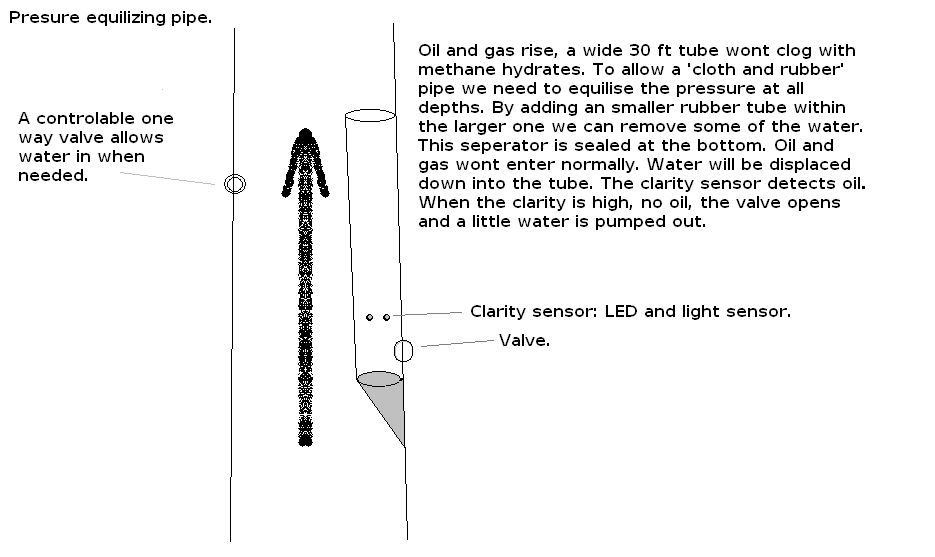
Lastly, This structure, particularly the canopy, can be constructed from modular patches of material and put together with a heavy volunteer input. Final assembly and folding is easy with thousands of volunteers hard with hundreds of cranes and complex jugs.
Deployment should be done with fishing boats and barges and the big tent should be sized for the available vessels. There are several natural oil seeps that this technology may also work on.
Someone needs to rally the necessary materials and resources to get these equi-pressure caps and bladder based contained slicks made and deployed.
Lets get going on the underwater circus tents; the circus in Washington and London isn't getting us anywhere.
Sunday, May 30, 2010
Why Rudd can't get the mining tax right.
Why can't Kevin Rudd get the number correct in taxation and investment. They're not lying, they simply can't bring themselves to believe that their theory of money, profit and interest is fundamentally wrong.
Interest and profit are the product of three things. Time preference, risk cost, and inflation expectations.
K Rudd thinks he can control the first by printing money at the RBA, so do some in the RBA. He can't, we're in a mess globally because governments and central banks have the same false idea. Time preference is a personal thing. Artificially low interest doesn't change it. It just confuses investors and borrowers about what kind of investments will succeed long term. Their investments don't match their own long term demands or anyone elses.
Rudd thinks he can control risk by promising to bail out failed mining projects: he can't even spell Moral hazard but the mining industry and stock markets can. Many less viable mining projects would start, most would fail and the deficit would go exponential. That's the sovereign risk.
Rudd inflation expectations are in fairy land. If it weren't for paranoid banks reading the Austrian School warnings an dumping those bail outs into excess reserves we would have global hyperinflation by now.
Most Australians share one of these miss interpretations. Academics and public servants share them all.
Interest and profit are the product of three things. Time preference, risk cost, and inflation expectations.
K Rudd thinks he can control the first by printing money at the RBA, so do some in the RBA. He can't, we're in a mess globally because governments and central banks have the same false idea. Time preference is a personal thing. Artificially low interest doesn't change it. It just confuses investors and borrowers about what kind of investments will succeed long term. Their investments don't match their own long term demands or anyone elses.
Rudd thinks he can control risk by promising to bail out failed mining projects: he can't even spell Moral hazard but the mining industry and stock markets can. Many less viable mining projects would start, most would fail and the deficit would go exponential. That's the sovereign risk.
Rudd inflation expectations are in fairy land. If it weren't for paranoid banks reading the Austrian School warnings an dumping those bail outs into excess reserves we would have global hyperinflation by now.
Most Australians share one of these miss interpretations. Academics and public servants share them all.
Thursday, May 27, 2010
The Gulf oil leak.
If the top kill works its almost all over but if it fails there will be hell to pay.
My solution would be to stick a tent on it. Make a plastic/canvas tube 20 metres across and 200 metres long with a balloon at the top. Add oil removal lines on the sides of the balloon at its widest point. At 200 metres above the sea floor the methane hydrates should not be a problem, the 20 m pipe is wide enough for turbulence to clear them and they will accumulate above the pump-out lines.
Just in case add a small electric UAV tethered to a power supply on the side of the tent/giant pipe. The UAV is inside the balloon. Why there wasn’t a UAV inside the hat structure they put on it beats me. Idiots I guess.
Because its in the oil it will need the same sonar sensors as a PIG, a cleaning robot used in oil pipe lines. This cleaning robot would have a high pressure hot water hose to blast any goop clear of the pump-out lines. The pump-out lines pump down and out. Hydrates and tars float. Provision is added for a solvent input line.
The tent would be anchored to the sea bed with big concrete blocks. This giant pipe wont plug the hole but buys time. It also raises the option of adding a water exclusion collar to the bottom so this tent/ Giant pipe is eventually full of ‘clean’ oil eliminating the dewatering process with the oil. Also if your smart such a collar has an ‘airlock’ waterlock to allow UAV’s to go in and out.
Once this is all over make one tent/ giant pipe with a zipper down the side and store it and the USV’s for any new accident.
Eventually someone will discover that its cheaper to drill in the sea bed on a hydrogen filled dome with telepresence robots replacing the crew. Fully automated sea bed drilling rigs.
My solution would be to stick a tent on it. Make a plastic/canvas tube 20 metres across and 200 metres long with a balloon at the top. Add oil removal lines on the sides of the balloon at its widest point. At 200 metres above the sea floor the methane hydrates should not be a problem, the 20 m pipe is wide enough for turbulence to clear them and they will accumulate above the pump-out lines.
Just in case add a small electric UAV tethered to a power supply on the side of the tent/giant pipe. The UAV is inside the balloon. Why there wasn’t a UAV inside the hat structure they put on it beats me. Idiots I guess.
Because its in the oil it will need the same sonar sensors as a PIG, a cleaning robot used in oil pipe lines. This cleaning robot would have a high pressure hot water hose to blast any goop clear of the pump-out lines. The pump-out lines pump down and out. Hydrates and tars float. Provision is added for a solvent input line.
The tent would be anchored to the sea bed with big concrete blocks. This giant pipe wont plug the hole but buys time. It also raises the option of adding a water exclusion collar to the bottom so this tent/ Giant pipe is eventually full of ‘clean’ oil eliminating the dewatering process with the oil. Also if your smart such a collar has an ‘airlock’ waterlock to allow UAV’s to go in and out.
Once this is all over make one tent/ giant pipe with a zipper down the side and store it and the USV’s for any new accident.
Eventually someone will discover that its cheaper to drill in the sea bed on a hydrogen filled dome with telepresence robots replacing the crew. Fully automated sea bed drilling rigs.
Sunday, May 16, 2010
The Mining supertax.
The Australian labour government is pushing a crippling 40% supertax on mining in Austarlia. This is on top of the 30% existing tax base in Australia. It makes mining non-viable in Australia! Its already crashed our stock market, trashed half the pension funds and split the union movement.
Michael Darby posted this on Facebook about the advocates of this tax.
http://www.facebook.com/?tid=1296892189218&sk=messages
I snipped the group part of the message.
Our opponents are dangerous ideologues who believe that the "people" of the whole of Australia somehow own the iron ore beneath the ground in WA and the coal beneath the ground in Queensland. This false and pernicious belief leads the Prime Minister repeatedly to assert that the purpose of his punitive tax is to gain a "fair share" for all Australians.
The false and tendentious "fair share" theory flaunts two important historical principles.
1. Security of Tenure
The first principle is that fundamental to the growth and development of modern industrial civilisation, a prospector owns title to what a prospector has found, subject to staking out the ground in accordance with a secure system of tenure, subject to bringing the claim into production within a reasonable (and known) period of time and subject also to paying a certain royalty to the sovereign government or to the owner of the land as the case may be. Where the sovereign government is the owner of the minerals, as in Queensland and WA, the State protects the interests of the landowner by imposing obligations upon the miner such as payment of compensation, notice of entry onto land, and rehabilitation of damage. Of vital importance to this process, from the moment a prospector first registers an interest in a prospect, the rules must not be changed. Any alteration adverse to miners in the system of royalties, for example, has a retrospective effect which destroys the confidence of all future miners.
2. The sovereign governments are the States, not Canberra
Only a fool would suggest that West Australians or Queenslanders deserve a "fair share" of the Melbourne Cricket Ground or of Mt Kosciuszko or of the Barossa Valley wineries. The Prime Minister may be such a fool. In 1892 residents of the eastern colonies who wanted a fair share of Coolgardie gold booked a passage to Fremantle and tramped east with a pick and shovel. Or they set up business in Coolgardie as blacksmiths or farriers or hoteliers or butchers. In modern times most Australians own a "fair share" of coal and iron ore through their superannuation funds (already wounded by the anti-mining tax). Anyone seeking a larger "fair share" need only email the stockbroker, or apply for a job in Central Queensland or the Pilbara. Of course, any discussion of a "fair share" must take into account the huge contributions of mining companies in company tax, PAYG tax, and royalties to State Governments. The Canberra claque resents the idea of a relationship between miners and State Governments and wants a monopoly on exploitation of the mining industry.
The Canberra exploiters would do well to learn the lesson of the great Scot, Leslie Urquhart (1874-1933), whose Russian mining companies a century ago employed 40,000 workers and provided housing and amenities for them and their families. When the Bolsheviks stole his mines, Urquhart thankfully came to Australia and became the driving force behind Mount Isa Mines. The dwellers in fantasy land imagine that capital and expertise will hang around to get kicked in the guts.
These are among the points I have been making in talk radio programs, and I am pleased to report a consistently good response from presenters and other callers. Queensland Senate team leader for the DLP Tony Zegenhagen qldsec@dlp.org.au was the first political leader to come on board with his 27 April 2010 statement of unqualified opposition to the anti-mining tax, and I am pleased that Tony Abbott has followed.
This is a battle for the rights of miners worldwide, and for all who support civilisation.
Please nominate yourself as a Convenor, for your mine, your union, your town, your electorate, your university, your district or even for your State. My personal email address is michael@michaeldarby.net Phone me anytime on 0402 558 947 and I'll phone you straight back
Kind regards
Michael
-------------------------------------------------------------------------
We are in a huge fight. Previous labour governments have taken two or three terms to stuff things up this badly. Our best hope is that labour will self destruct over this folly.
Mining is costly and risky the profits are not windfalls or exploitation they are the real cost of high risk capital. That the PM Kevin Rudd and Treasurer Wayne Swan don't grasp this is catastrophic.
For those in the USA this tax is an order of magnitude larger than the tariff disputes that triggered the American civil war in 1861!
Michael Darby posted this on Facebook about the advocates of this tax.
http://www.facebook.com/?tid=1296892189218&sk=messages
I snipped the group part of the message.
Our opponents are dangerous ideologues who believe that the "people" of the whole of Australia somehow own the iron ore beneath the ground in WA and the coal beneath the ground in Queensland. This false and pernicious belief leads the Prime Minister repeatedly to assert that the purpose of his punitive tax is to gain a "fair share" for all Australians.
The false and tendentious "fair share" theory flaunts two important historical principles.
1. Security of Tenure
The first principle is that fundamental to the growth and development of modern industrial civilisation, a prospector owns title to what a prospector has found, subject to staking out the ground in accordance with a secure system of tenure, subject to bringing the claim into production within a reasonable (and known) period of time and subject also to paying a certain royalty to the sovereign government or to the owner of the land as the case may be. Where the sovereign government is the owner of the minerals, as in Queensland and WA, the State protects the interests of the landowner by imposing obligations upon the miner such as payment of compensation, notice of entry onto land, and rehabilitation of damage. Of vital importance to this process, from the moment a prospector first registers an interest in a prospect, the rules must not be changed. Any alteration adverse to miners in the system of royalties, for example, has a retrospective effect which destroys the confidence of all future miners.
2. The sovereign governments are the States, not Canberra
Only a fool would suggest that West Australians or Queenslanders deserve a "fair share" of the Melbourne Cricket Ground or of Mt Kosciuszko or of the Barossa Valley wineries. The Prime Minister may be such a fool. In 1892 residents of the eastern colonies who wanted a fair share of Coolgardie gold booked a passage to Fremantle and tramped east with a pick and shovel. Or they set up business in Coolgardie as blacksmiths or farriers or hoteliers or butchers. In modern times most Australians own a "fair share" of coal and iron ore through their superannuation funds (already wounded by the anti-mining tax). Anyone seeking a larger "fair share" need only email the stockbroker, or apply for a job in Central Queensland or the Pilbara. Of course, any discussion of a "fair share" must take into account the huge contributions of mining companies in company tax, PAYG tax, and royalties to State Governments. The Canberra claque resents the idea of a relationship between miners and State Governments and wants a monopoly on exploitation of the mining industry.
The Canberra exploiters would do well to learn the lesson of the great Scot, Leslie Urquhart (1874-1933), whose Russian mining companies a century ago employed 40,000 workers and provided housing and amenities for them and their families. When the Bolsheviks stole his mines, Urquhart thankfully came to Australia and became the driving force behind Mount Isa Mines. The dwellers in fantasy land imagine that capital and expertise will hang around to get kicked in the guts.
These are among the points I have been making in talk radio programs, and I am pleased to report a consistently good response from presenters and other callers. Queensland Senate team leader for the DLP Tony Zegenhagen qldsec@dlp.org.au was the first political leader to come on board with his 27 April 2010 statement of unqualified opposition to the anti-mining tax, and I am pleased that Tony Abbott has followed.
This is a battle for the rights of miners worldwide, and for all who support civilisation.
Please nominate yourself as a Convenor, for your mine, your union, your town, your electorate, your university, your district or even for your State. My personal email address is michael@michaeldarby.net Phone me anytime on 0402 558 947 and I'll phone you straight back
Kind regards
Michael
-------------------------------------------------------------------------
We are in a huge fight. Previous labour governments have taken two or three terms to stuff things up this badly. Our best hope is that labour will self destruct over this folly.
Mining is costly and risky the profits are not windfalls or exploitation they are the real cost of high risk capital. That the PM Kevin Rudd and Treasurer Wayne Swan don't grasp this is catastrophic.
For those in the USA this tax is an order of magnitude larger than the tariff disputes that triggered the American civil war in 1861!
Wednesday, April 21, 2010
Fixing the flaw in education. Creating job creators.
We have an economic crisis with many people out of a job and many looking for a comfortable job that does not even exist. The real problem is that we have an education system that churns out people that have expectations of an easy life, short working hours and no need to take risks in business or do any heavy or hard drudge work.
Our schools produce people that are well trained in filling out forms but de-skilled in basic entrepreneurship.
Our universities wash out thousands in first year. These kids go on to work using partial skill sets and no training in business creation. They gravitate to public service and become trapped there. Their only hope of advancement comes from an ever expanding bureaucracy and an ever expanding government deficit. That hope is doomed to fail.
A large percentage of businesses are kicked off by university undergraduates and graduates who were never taught the basics of business formation and operation. They are good engineers, technicians and programmers but that can't file a patent, copy write or self publish a book. They can't write a contract to save their life and they are taught not to trust those 'capitalist pigs' that can. Some good people landed in jail after the dot com bust that way.
We need business studies subjects to be created for scientists, environmentalists, social scientists, etc. These courses need to be in first year so we don't miss the kids that drop out in the first year but still wind up working in the field as assistants or whiz kid CEO's. This also allows students to see what subjects lead to a job and what are a waste of time and the governments money. Marxist theories of bicycle maintenance wont get you a job.
Our schools produce people that are well trained in filling out forms but de-skilled in basic entrepreneurship.
Our universities wash out thousands in first year. These kids go on to work using partial skill sets and no training in business creation. They gravitate to public service and become trapped there. Their only hope of advancement comes from an ever expanding bureaucracy and an ever expanding government deficit. That hope is doomed to fail.
A large percentage of businesses are kicked off by university undergraduates and graduates who were never taught the basics of business formation and operation. They are good engineers, technicians and programmers but that can't file a patent, copy write or self publish a book. They can't write a contract to save their life and they are taught not to trust those 'capitalist pigs' that can. Some good people landed in jail after the dot com bust that way.
We need business studies subjects to be created for scientists, environmentalists, social scientists, etc. These courses need to be in first year so we don't miss the kids that drop out in the first year but still wind up working in the field as assistants or whiz kid CEO's. This also allows students to see what subjects lead to a job and what are a waste of time and the governments money. Marxist theories of bicycle maintenance wont get you a job.
Grounding aircraft kills people.
Hundreds of planes grounded. People stranded, trade interrupted all by one little volcanic eruption in the middle of the Atlantic. But at least no body died right. Wrong! grounding aircraft kills people.
People haven’t realised yet. The media is silent but people will have died because of the no fly rules. Most organs for organ donations go by air. Ground transport is too slow. A percentage of people on waiting lists for organ transplants die while they wait. There will have been several dozen death in Europe as a result. There are now disputes about the MET Office computer modeling that led to the grounding of all those air craft.
http://wattsupwiththat.com/2010/04/21/airlines-blame-flawed-computer-modelling-for-up-to-1-7-billion-loss/
If the met office gets sued for damages you will see subsequent legal actions on these deaths. It will take a few weeks, end of the month, for anyone to notice but someone will notice a bump in statistics in mortality of people on organ waiting lists.
The no fly will have also fowled up hundreds of chemotherapy treatments and radiation therapy treatments. These drugs and isotopes are time sensitive and generally go by air. No one is talking about this aspect.
People haven’t realised yet. The media is silent but people will have died because of the no fly rules. Most organs for organ donations go by air. Ground transport is too slow. A percentage of people on waiting lists for organ transplants die while they wait. There will have been several dozen death in Europe as a result. There are now disputes about the MET Office computer modeling that led to the grounding of all those air craft.
http://wattsupwiththat.com/2010/04/21/airlines-blame-flawed-computer-modelling-for-up-to-1-7-billion-loss/
If the met office gets sued for damages you will see subsequent legal actions on these deaths. It will take a few weeks, end of the month, for anyone to notice but someone will notice a bump in statistics in mortality of people on organ waiting lists.
The no fly will have also fowled up hundreds of chemotherapy treatments and radiation therapy treatments. These drugs and isotopes are time sensitive and generally go by air. No one is talking about this aspect.
Sunday, April 11, 2010
Skipping Moores Law with unlimited detail
Moore's law predicts that the number of transistors per CPU chip will increase with resulting processing power doubling every two years or so. This process is driven by game software. There's no good reason for a computer doing accounting, administration or email to go so fast. Web browsing and other fast software has been riding the wave but its gaming that pushes everything along. 3d Graphics is the great challenge of computer game, graphics lag the biggest effect of any failure to meet that challenge.
Now a couple of very smart software writers in Brisbane Australia have come up with a piece of software that side steps most of the problems giving unlimited detail.
Its a compression process and search based decompression process that puts pixels on the screen without creating in memory somewhere the whole virtual world including all the unseen bits. It works with pure point cloud data and not polygons. This means that polygon counts are irrelevant. The graphics are pure points of colour in memory.
http://unlimiteddetailtechnology.com/home.html
Some have said that unlimited detail is impossible because it would require unlimited random access memory. I'm always amazed at the ability of the media to find some academic that is eager to say If I can't figure out how to do it nobody can. It rebinds me of the statement."Those who can, do; those who can't, teach."
I think they have something very powerful. By its self it will allow even the most basic game to surpass the high resolution images seen in movies and ads.
However it may not end there if their software works with any point cloud data input then not only can the laser scan objects into games but they could use ladar and bifocal cameras to map in landscapes, trees, whole forests. Live animals, people and buildings.
That's because a ladar produces point cloud data and the bifocal camera can use an Boolean AND algorithm that creates point cloud data from a scene. Any point that has the same colour at a given focal length from both cameras defines a point. If it remains as the camera orbits the target a point is archived. Its a little more complex but not much. Point cloud data and voxels are the same thing. Voxel means a volumetric pixel. 3D pixel. http://en.wikipedia.org/wiki/Voxel
We may see within a year or two photo-realistic game worlds. That wont eliminate Nvidia and ATI though some may fear that. Once the polygon problem is solved the next great challenge is game AI and more realistic animations. We will want our virtual worlds to move right not just look right. While Unlimited Detail Technology can do awesome animation I expect such motions must be integrated to other parts of the game physics, lighting etc.
The other challenge is creating fast low memory point cloud editing systems that creates convincing objects quickly and easily. Such editors exist and are powerful but its easy to get things wrong. If Unlimited Detail Technology is adopted by a object editor then even the editing of the objects could be done on smaller computers. Also don't forget that it will very quickly go 3d on the screen.
Another break through may follow. Very fast Voxel physics. If they can use a search algorithm to find the colour for each screen pixel then a second 'camera' may be used to look at the data in another way. What's the closest voxel doing? Is it solid, stationary, moving, fluid, flexible, gas? Which are my bounding box, avatar, clothing. Is it the ground. A voxel that can move could be water, fog, rain, bullets, magic fire balls, or just grass crushing under foot. By adding a byte to the points in the cloud you could add 255 options.
The world of computer gaming is about to spike. Hang on to your hats it will be a wild ride.
Now a couple of very smart software writers in Brisbane Australia have come up with a piece of software that side steps most of the problems giving unlimited detail.
Its a compression process and search based decompression process that puts pixels on the screen without creating in memory somewhere the whole virtual world including all the unseen bits. It works with pure point cloud data and not polygons. This means that polygon counts are irrelevant. The graphics are pure points of colour in memory.
http://unlimiteddetailtechnology.com/home.html
Some have said that unlimited detail is impossible because it would require unlimited random access memory. I'm always amazed at the ability of the media to find some academic that is eager to say If I can't figure out how to do it nobody can. It rebinds me of the statement."Those who can, do; those who can't, teach."
I think they have something very powerful. By its self it will allow even the most basic game to surpass the high resolution images seen in movies and ads.
However it may not end there if their software works with any point cloud data input then not only can the laser scan objects into games but they could use ladar and bifocal cameras to map in landscapes, trees, whole forests. Live animals, people and buildings.
That's because a ladar produces point cloud data and the bifocal camera can use an Boolean AND algorithm that creates point cloud data from a scene. Any point that has the same colour at a given focal length from both cameras defines a point. If it remains as the camera orbits the target a point is archived. Its a little more complex but not much. Point cloud data and voxels are the same thing. Voxel means a volumetric pixel. 3D pixel. http://en.wikipedia.org/wiki/Voxel
We may see within a year or two photo-realistic game worlds. That wont eliminate Nvidia and ATI though some may fear that. Once the polygon problem is solved the next great challenge is game AI and more realistic animations. We will want our virtual worlds to move right not just look right. While Unlimited Detail Technology can do awesome animation I expect such motions must be integrated to other parts of the game physics, lighting etc.
The other challenge is creating fast low memory point cloud editing systems that creates convincing objects quickly and easily. Such editors exist and are powerful but its easy to get things wrong. If Unlimited Detail Technology is adopted by a object editor then even the editing of the objects could be done on smaller computers. Also don't forget that it will very quickly go 3d on the screen.
Another break through may follow. Very fast Voxel physics. If they can use a search algorithm to find the colour for each screen pixel then a second 'camera' may be used to look at the data in another way. What's the closest voxel doing? Is it solid, stationary, moving, fluid, flexible, gas? Which are my bounding box, avatar, clothing. Is it the ground. A voxel that can move could be water, fog, rain, bullets, magic fire balls, or just grass crushing under foot. By adding a byte to the points in the cloud you could add 255 options.
The world of computer gaming is about to spike. Hang on to your hats it will be a wild ride.
Monday, March 29, 2010
Church in second life - A messianic passover.
I've just attended a church service in Second Life.
The presentation was a messianic Passover. Messianic Jews are Jewish Christians that preach that Jesus is the messiah of the Jews with a full exposition of the gospel in Hebrew (and English in this case). They show you how the passover and other religious services in Israel pointed to and prophesied Jesus Christ and his sacrifice. The service was in a dedicated sky-box at “You are loved ministries” at EC Beach Community. (in Second Life a sky-box is a building or platform that seems way up in the sky above the clouds or in them.) This was a big sky box at an amazing height. Eternal creations owns 6 sims in second life forming the EC island.
Rivkah and Judah Sorbet gave the sermon with assistance from others. Included was a special interactive tray where selecting items did things like filling or drinking wine. Consuming the symbolic foods and breaking the bread. All these parts of the ritual have teaching function that is often lost on people practicing them because they don't see the connection to the messiah-ship of Christ.
Here are some pictures.


 We crossed the red sea and then went to watch a movie. Rivkah gave an appeal worthy of Billy Graham. An evangelical call to unbeleivers to come and ask Jesus to take their sins away and help run their life properly. Here was then music performances and a farwell.
Some stayed afterwards to talk and thank the organisers for the great church presentation.
As someone pointed out church is people not buildings. This is even truer in second life where buildings come and go with the touch of a button. But still great art and great teaching go together.
Thank you everyone who made it work.
[Click on the pictires for full screen views.]
The presentation was a messianic Passover. Messianic Jews are Jewish Christians that preach that Jesus is the messiah of the Jews with a full exposition of the gospel in Hebrew (and English in this case). They show you how the passover and other religious services in Israel pointed to and prophesied Jesus Christ and his sacrifice. The service was in a dedicated sky-box at “You are loved ministries” at EC Beach Community. (in Second Life a sky-box is a building or platform that seems way up in the sky above the clouds or in them.) This was a big sky box at an amazing height. Eternal creations owns 6 sims in second life forming the EC island.
Rivkah and Judah Sorbet gave the sermon with assistance from others. Included was a special interactive tray where selecting items did things like filling or drinking wine. Consuming the symbolic foods and breaking the bread. All these parts of the ritual have teaching function that is often lost on people practicing them because they don't see the connection to the messiah-ship of Christ.
Here are some pictures.

86 people attended.
Thats a lot for any event in a computer MMO game.
Lag was bad but everyone was so interested it did not matter.

Its as very nice building. Everything was StoneAngle Ingelwood's handy work. Even the briliant tray.

The tray on the wall showed us what to do on our tray.

We all had a tray. I'm the one in the blue black solar cell spacesuit.

We then all wandered out to the red sea (white foam in the distance). Lag was bad but not enough to deter us.

Some stayed afterwards to talk and thank the organisers for the great church presentation.
As someone pointed out church is people not buildings. This is even truer in second life where buildings come and go with the touch of a button. But still great art and great teaching go together.
Thank you everyone who made it work.
[Click on the pictires for full screen views.]
Tuesday, March 16, 2010
Image holder post

I'll be sticking various images here from time to time.

Gale crater roofed in.


Another variation. The purple is really red and blue warning stripes.
Minecraft stuff . Treasure chest

galecrater garden


Sky resources http://minecraft.curseforge.com/projects/sky-resources
Crucible{brick], over lava for heat. Two fluid droppers only one needed if another heat source is used. Fluid metal in space below them with Alchemy block below. Heat sources torches, lava, furnace and obsidian.

A header image.

Wednesday, March 10, 2010
Green dragon boats
Sea steading is the idea of colonising the open ocean with homesteads and floating cities. The greatest challenge is waves that can swamp a sea stead and cause a constant rocking motion that some people find impossible to endure for long. The seasteads can be made smaller if we 'throw' the food production system overboard. I.e. Move any farming out to smaller structures that are built to float independent of our seasteads.
Plants don't get sea sick.
Though to much agitation can puree the garden there are systems that could work if we create sheltered waters with some kind of floating break wall. More on that at http://appliedimpossibilies.blogspot.com/2010/03/float-ponds-in-second-life.html and http://appliedimpossibilies.blogspot.com/2010/03/sea-steading-as-fleet-of-vessel-classes.html
However in more open waters a sea stead floating farm has to be more robust and complex. In looking at this I developed the fluke boat.
 I have refinned these vessels a little to create a new craft the dragon boat.
I haven't done the engineering but believe they will be technologically possible in the near future. Here's a work up in second life. Space Destiny sim.
 What we have here is dragon boat, a mock up of a sea fort sea stead [not mine but good] a sandy coloured wharf, and a floating algae oil farm (green & blue).
The dragon boat green house is a robot. The head is radar and ladar units in a decorative pod. Ladar is laser radar a system for detecting other vessels and mapping the waves at short range. It also has a sonar under the water line and GPS. The main bay is a greenhouse with soil, hydroponics or airponics. Water comes from reverse osmosis or forward osmosis with fertiliser drawing water through a membrane. Most of the water is fully recycled through a fish farming system (fresh water fish). The craft unmanned with automated systems. In good weather and low waves the farmer boards to plant, tend and harvest.
The boat has flukes: wave power systems that propel the vessel.
 The fluke is the blue wing. It hinges with the waves but is retarded. As the waves lift the boat the fluke resists and forces water backwards. As the water is heavier than the boat the boat moves forward. Fluke boats are not fast but they can sail for months limited only in the durability of the hinges and retarding springs. Such things can be built to last years but I'd still want to check them every few months.
The dragon boat has a high streamlined bow and stern for a reason, its not just decoration. These structures are hollow and buoyant.

When a big wave hits them the volume in the water increases and the centre of balance shifts. The bow or stern rides up the wave rather than digging into it. Since there is no deck for the water to catch on and fill it is harder to sink. In high seas the plants get a rough ride. They may be damaged but they aren't destroyed.
Two or more dragon boats could be integrated into a multi hulled vessel.
However I favour the idea of retractable linkages(not shown). That allow you to switch and swap units in the double or triple hull form. This also allows them to break the linkages and stand clear of each other in a heavy storm. Since in the tropical oceans the sea is calm in the morning and stormy in the afternoon and early night this means most would be linked in the morning and delink and scatter by 3 pm.
 In reality the vessels hull may be wider and sit lower in the water. With extra volume below the water line but second life has its limits.
Plants don't get sea sick.
Though to much agitation can puree the garden there are systems that could work if we create sheltered waters with some kind of floating break wall. More on that at http://appliedimpossibilies.blogspot.com/2010/03/float-ponds-in-second-life.html and http://appliedimpossibilies.blogspot.com/2010/03/sea-steading-as-fleet-of-vessel-classes.html
However in more open waters a sea stead floating farm has to be more robust and complex. In looking at this I developed the fluke boat.

I haven't done the engineering but believe they will be technologically possible in the near future. Here's a work up in second life. Space Destiny sim.

The dragon boat green house is a robot. The head is radar and ladar units in a decorative pod. Ladar is laser radar a system for detecting other vessels and mapping the waves at short range. It also has a sonar under the water line and GPS. The main bay is a greenhouse with soil, hydroponics or airponics. Water comes from reverse osmosis or forward osmosis with fertiliser drawing water through a membrane. Most of the water is fully recycled through a fish farming system (fresh water fish). The craft unmanned with automated systems. In good weather and low waves the farmer boards to plant, tend and harvest.
The boat has flukes: wave power systems that propel the vessel.

The dragon boat has a high streamlined bow and stern for a reason, its not just decoration. These structures are hollow and buoyant.

When a big wave hits them the volume in the water increases and the centre of balance shifts. The bow or stern rides up the wave rather than digging into it. Since there is no deck for the water to catch on and fill it is harder to sink. In high seas the plants get a rough ride. They may be damaged but they aren't destroyed.
Two or more dragon boats could be integrated into a multi hulled vessel.
However I favour the idea of retractable linkages(not shown). That allow you to switch and swap units in the double or triple hull form. This also allows them to break the linkages and stand clear of each other in a heavy storm. Since in the tropical oceans the sea is calm in the morning and stormy in the afternoon and early night this means most would be linked in the morning and delink and scatter by 3 pm.

Sunday, March 07, 2010
Float ponds in Second life
I have created a little display of sea farming, sea steading and fish farming in Second Life. Its at the EDAKent at Scilands. Look up Wesley Farspire in game I'll show you around.
SLURL http://maps.secondlife.com/secondlife/EDAKent/38/199/25
 What's a float pond? I hear you ask.
A liferaft with plants in it. The design is my own but some work was done on this in the 1970's. Today we have the plastics and the plants so we can begin.
These SL float ponds are about 10 m across in reality they would be 20 to 50 m in diameter. The key is flexibility to roll with the waves, design for recycling and mass production. (life rafts are still often hand made)

Most are swamp or aquatic plants. Some are salt tolerant shore plants. A covered pond with a sturdy deck could grow vegetables.

See more at:
http://vacoyecology.com/Bubble_ponds_fluke_boats.html
More pictures below.

This is an open ocean sea stead fish farm.
The floating algae farm, green, feeds small fish in one of the spherical cages. The little fish feed the big fish in the other cage. At the back is a solar powered upwelling pump bringing rich deep water up from 300 meters or more down. The surface of the ocean is relatively starved of fertility but rich in light. The upwelling pump fixes that. The result is an increase in the abundance of fish and more food for humanity.

Look, a tree?
In theory a float pond could even grow wood. Mangroves anchoured into a floating mesh with extra buoyancy and a membrane to prevent mud from falling out the bottom or washing over the edge. It could be fertilized with plant matter and algae.
It would however be of little economic value. We need to restore the mangroves to our shore lines. I'll post on that later.
Why have a sea steading display in a space related sim in SL?
Because to feed the next 30 billion we need to colonize the seas and the stars and every where else. If you can master the sea then space is easy. There's more of it and there are no storms. Key resources can be found on the sea bed, the ocean surface, as well as other planets and asteroids.
One of the criticisms of space colonisation is that 'we should fix the earth before going off world.' This is just plain wrong! Some of us believe that we can do both at once and we will never 'fix' the world to everyone's satisfaction. The real challenge is to reduce the impacts on species. Preventing extinctions. We have solutions for this to.
SLURL http://maps.secondlife.com/secondlife/EDAKent/38/199/25

A liferaft with plants in it. The design is my own but some work was done on this in the 1970's. Today we have the plastics and the plants so we can begin.
These SL float ponds are about 10 m across in reality they would be 20 to 50 m in diameter. The key is flexibility to roll with the waves, design for recycling and mass production. (life rafts are still often hand made)

Most are swamp or aquatic plants. Some are salt tolerant shore plants. A covered pond with a sturdy deck could grow vegetables.

See more at:
http://vacoyecology.com/Bubble_ponds_fluke_boats.html
More pictures below.

This is an open ocean sea stead fish farm.
The floating algae farm, green, feeds small fish in one of the spherical cages. The little fish feed the big fish in the other cage. At the back is a solar powered upwelling pump bringing rich deep water up from 300 meters or more down. The surface of the ocean is relatively starved of fertility but rich in light. The upwelling pump fixes that. The result is an increase in the abundance of fish and more food for humanity.

Look, a tree?
In theory a float pond could even grow wood. Mangroves anchoured into a floating mesh with extra buoyancy and a membrane to prevent mud from falling out the bottom or washing over the edge. It could be fertilized with plant matter and algae.
It would however be of little economic value. We need to restore the mangroves to our shore lines. I'll post on that later.
Why have a sea steading display in a space related sim in SL?
Because to feed the next 30 billion we need to colonize the seas and the stars and every where else. If you can master the sea then space is easy. There's more of it and there are no storms. Key resources can be found on the sea bed, the ocean surface, as well as other planets and asteroids.
One of the criticisms of space colonisation is that 'we should fix the earth before going off world.' This is just plain wrong! Some of us believe that we can do both at once and we will never 'fix' the world to everyone's satisfaction. The real challenge is to reduce the impacts on species. Preventing extinctions. We have solutions for this to.
Wednesday, March 03, 2010
Sea steading as a fleet of vessel classes.
Most think of sea steading in terms of cities on the sea with a single design and structure. I.e.
Oceania.


Modern cities are not built with one architecture dominating the landscape. Why should we try that at sea?
Oceania.

Or one of the more modern TSI sea stead designs.

or a spar or flip ship design.

However, it is highy likely that a sea stead complex would be a mix of such systems intergrated into a city.
Something like this.

Here we have a large variety of vessels and structures.
Dark Green are ship based seasteads and unmanned floating farm units. These are powered to tow the other structures as required.
Gray are wave damping floating break-walls or "wave-steads". Most of these would be light industrial, chemical plants or farm decks. These rest on wave-damping structures that create calm water in the areas behind them. They need not be continuous as long as the wave damped areas they create overlap. They are not to scale width wise; they would be much thinner.
Light Green is a large floating mat based sea stead/ farm system. A Continuous mat of float ponds and inflatable decks with switchable rigidity. (Floating digital matter.)
Orange are large clusters of interlocked seasteads forming the business center. Note one is also a ship bases sea stead for trade further afield.
Yellow is algae oil farms: very big but modular arrays of floating bladders of fuel producing organisms.
Blue are small spars, flip ship like spars and other smaller units.
The area enclosed by the gray wave damping units is calmer with wave heights ~1% of the normal height. Since most seasteaders are hoping to pick an area where average wave heights are 3 -5 meters (9-17 feet) this would reduce them to 3 - 5 cm (1-3 inches) 10% of the energy of those waves could be tapped for energy by the wave-steads.
Everything would be held in place by a array of large deep sea anchors.

A wave stead rests on truck like axles connected to non circular buoyant tubes. These Salters duck tubes, cream in the picture, rotate in response to the action of the waves. Because the wave forces are converted to rotating oscillation we can tap off that force as usable energy and the bulk of the wave energy does not convert into heave or rocking on the sea stead on top. Energy only units would have a skeletal deck and no super structure. The first duck, visible, Damp the waves 90% The second, hidden, damps the residual 10% down by 90%.
The ship based sea stead would look like this. There's a man standing on the bow for scale. 
- Float ponds and algae bladders. With some robot boats and a small spar based sea stead. See http://vacoyecology.com/Bubble_ponds_fluke_boats.html

The top three structures could all be used to some extent in the sheltered area of the center.
Modern cities are not built with one architecture dominating the landscape. Why should we try that at sea?
Subscribe to:
Posts (Atom)