Tuesday, April 19, 2011

Human rights for mother earth?

 Some want to grant mother earth human rights.
http://www.foxnews.com/world/2011/04/18/prepares-debate-rights-mother-earth/
Defining what is needed to sustain the earth and humanity at the same time is easy? 
  • Avoid extinction of properly defined species by allowing ownership and breeding. Farming endangered species if needed, keeping them as pets if possible, and creating seed banks and private parks.
    • Develop tools to increase the efficiency, productivity and intensity of some natural resource systems so that others can be rested allowing recovery. Intensive crops and hydroponics replacing unproductive peasant farming.
      • Develop industries that buy degraded systems, speed its recovery and sell at a profit the improved land or resource. Private parks and Permaculture. [Only in a government monopoly can land become so degraded that it can't be restored. Love Canal was an official government and army waste dump before Hooker Chemical were given federal orders to dump there. "The corporation refused to sell, citing safety concerns, and took members of the school board to the canal and drilled several bore holes to demonstrate that there were toxic chemicals below the surface." Wiki Sale of the site]
      • Where viable recycle; where that's not viable, store waste in safe land fill for later mining and recycling. The first profitable landfill mine was in Israel in the 1950's. There are hundreds today.
      • Develop a diversity of energy technologies, using fossil fuel to increase the wealth of society and buy time while other energy technologies are matured to cover base load energy and transport.
      • Rule no technology out unless it proves truly and indisputably unsafe and uninsurable.
      • Farm the seas don't just hunt them blindly. Fertilise, sow and reap for maximised yields. Farmers must own their area of the sea.
      • Finally, remember that there are 3 other terrestrial planets, 80 moons and 1 billion asteroids in this solar system. All have resources. 
      We already have a name for the key tool that allows all of this, its called 'capitalism and private property rights'.
      If property rights are allocated properly then it has the same effect as granting rights to the earth itself because in the free market no land or resources has a zero value. When you declare something priceless and strip away property rights you make it worthless and put maintenance in the hands of disinterested bureaucrats who can easily drop the ball and become more concerned about the size of their desk than the species they protect.

      Friday, April 08, 2011

      If climate change was real and effected agriculture

      Assuming it was not based on flawed data, fraudulent scientific papers and exaggerated media claims used in UN documents. Assuming the world was warming and that changed growing patterns world wide, what would we do?
      1. We would need to retrain millions of farmers. Formal training for farmers, not agronomists, ordinary farmers, is needed anyway. Over 60% of Australian farmers are past retirement age. We need to train people to replace them anyway. Farming is not for amateurs. 80% of the third worlds farmers need training too regardless of climate change. Private, web or magazine based teaching is the cheapest option for agricultural extension with some investment in vehicle mobile teaching tools in remote areas. 
      2. As seasonal patterns shift farmers will need to change their choice of seed stock and crop variety. Seed company's have ample diversity in different seed stocks for wetter, drier, colder and hotter growing conditions. 
      3. Some farmers will need multiple on farm seed storage for several varieties so they can buy cheap, store long, sow what they need in rush without running fowl of a scramble for seed stocks and rising prices when it apparent that they will need a given seed type.
      4. We need to plant wind brakes, hedges and grass hedges [Lev 19:9]. These block hot and cold wind, flows of frost carrying cold air and by stilling the air over the field it reduces evaporative water loss. It can with good design modify the temperature back to the pre-greenhouse temperature where desired. If fodder, fruit or nut yielding trees are used they are an investment with a quicker return than wood. Such plantings should be tax deductible and should be depreciated as machinery is.
      5. When greenhouse models predicted increases in rain fall the IPCC painted it as bad by calling it Increased rainfall variability and talking about flash floods. That sounds bad but by simply adding artificial bends and meander in streams, overflow channels and ponds we can catch these rains. 
      6. At the smaller scale swales* or ploughing with a Yeomans** aerating plough make the water move into the ground rather than running off. The key is to hold the water on the land long enough to allow the water to move into the water table where it moves very slowly and feeds springs that run deep into the dry years. The most extreme but effective means of doing this is terracing. Even with all our modern technology we do much less terracing of farm land than our bronze-age ancestors did. why?
      7. Where increased drought is predicted we need cisterns. Covered water storage and underground canals. Ancient man could build these in the stone age. Can't we do better? Developing ways to make them cheap and easy to build should make you rich.
      8. Also in deserts we need to move to more drought tolerant crops with drip and underground porous pipe based irrigation. This makes the desert bloom. This means a shift from water hungry crops to things like dates, olives and fruiting cacti but moving from one mono-culture to another leaves you vulnerable. Mixing up different species and value adding removes the vulnerability to fickle market fluctuations. The boab tree seedling is the latest new desert cultivar. http://www.boabsinthekimberley.com.au/
      9. We are the first generation that don't move livestock away from drought enough. We also need to be ready and equipped to move livestock away from flood zones early. Using farmer to farmer agreements as a form of insurance and looking at transport and agistment for livestock as part of a drought insurance process. While individual regions are drought stricken often there is another accessible region that is not. If done well it could be cheaper than current government drought assistance. 
      10. We need to give our gazing land time to grow high and put down roots deep restoring soil carbon. This drought proofs and flood proofs farms. If we allow the animals to graze land too sparely they bite back the recovery growth and the grasses can't grow strong and deep, they have no energy. There is a solution Holistic Management created by Allan Savory and Jody Butterfield. http://holisticmanagement.org/
      11. Where floods are an increased risk we need to make hills creating high ground where there was none, so people and livestock can get above the torrent. About half the farms have the necessary equipment. The channels we dig to get the earth will catch flood sediment and retain water long after the flood is gone remaining green as the rest of the land browns.  
      12. We need to domesticate many new species. Why fear flood if you livestock is Hippopotamus or Capybara. Why fear drought if your farming a drought tolerant native desert grass or the boab. We are domesticating two new species a month world wide. If we farm endangered species, e.g. the American buffalo, we find that their population recovers. Why not farm seals for the skin and meat? Why not keep a hairy nosed wombat on your farm as a wild pet? Numbats and monkeys are good eating I'm told. Properly farmed they could feed millions.
      13. In the most extreme cases of weather based disruption we will need to build greenhouses and hydroponics. These are getting cheaper by the year and are far cheaper than replacing our energy infrastructure. They can be fully climate controlled. Climate change is irrelevant; They would work on Mars and even Venus. The air can be cooled with solar powered air-conditioning, heated with solar thermal and all water can be in theory retrieved and recycled by solar powered dehumidifiers. In practise it might be cheaper to deal with transpiration losses by hauling in water by rail or even truck. 
      14. We may need to develop radical new technologies: Machines that convert cellulose to starch, algae farms to supplement livestock feed supplies. These too can be air and water tight, recycling everything if needed to be. Even Food nano-fabricators are not in theory impossible there are people working on them today.
      All these things are doable, some may not be cheap but a little more inovation could make them as cheap as modern computer chips. Remember when a cheap computer cost a million dollars?
      Most of these things will need to be done anyway. If the government tries to do them it will never have enough money. Only by tapping the tools of the free market and developing new tools to capitalise individual farms and farmers (education and agricultural extension) will we succeed.
      World population is growing; Food production has always grown to match. The climate is always changing we need to be ready for anything. We have the tools and techniques its not impossible to adapt to anything.


      *If you don't understand any term feed it into wikipedia.
      ** Water For Every Farm. Using the Keyline plan. By P.A.Yeomans.  http://www.keyline.com.au/   also uses swales.
      Australians Bill Mollison and David Holmgren developed some of these ideas into Permaculture. I recommend a Permaculture course. I've done one. Find a teacher that's greenhouse neutral, there are a few.

      Thursday, March 24, 2011

      If sea level rise was real and became a problem

      If the worst case scenarios for sea level rise come true and we get between 30 cm and/or 9 metres of sea level rise in 100 years, what's the worst that could happen?
      • We would need to rebuild our coastal resorts. We do that anyway about every 60 years. They are not built to last and go out of style soon after their paid off. If its profitable no government funds are needed. If its not profitable blow it up and make a park.
      • We would have to jack up or move a few hundred historic buildings. At five million each that's a few billion and half that will be millionaires 'moving house'. 
      • Some low lying towns will need to dig a hole and build a hill in or next to town. If they are smart all new structures will be multi-story and will be built on that hill or will be connected to it with a bridge at 3 to 9 meters above sea level. Turn the hole into a nice lake and put floating houses on it. Most towns already own the needed earth moving equipment. In 100 years you can heap up a lot of dirt. (I do not trust dykes and levee banks, too many have failed, why make them when for the same cost you can raise the town.)  If you loose crops in a flood then you were growing the wrong crops in the first place. Grow something you can harvest before the flood season. 
      • We need to farm coral in the pacific to make more sand fill to adjust the hight and shape of about 300 atolls. The coral will grow up to match sea level rise but there will be lags and cases where the natural process messes up the real-estate values- atolls move about; real-estate boundaries don't (they could and should on atolls but don't now). 
      • We would need to "build up" on those islands and out over the lagoon or the open sea with floating factories, malls and apartments. Most of the low islands of the Pacific, Caribbean and Indian ocean are under developed and needs reconstruction anyway. Those Island nations own millions of hectares of sea bed with minerals; They only think their poor. If its profitable government need not interfere.
      • Some coastal farms will need to switch to growing salt tolerant crops or fish. We already have a salt water irrigated grain:  Palmer's grass ( Distichlis palmeri ) A biofuel crop: Salicornia bigelovii and a sugar crop: Nypa fruticans.(mangrove palm) There are many other halophytes, salt tolerant plants, being developed as crops.
      • Some third world estuarine systems will need to be redesigned and rebuilt with all of the above measures. However since they are third world countries they need the development anyway. If they can't discover (or refuse to accept) the tools of modern democracy, development and capitalism then they will stave long before the sea rises to get them.
      That's it! A few trillion dollars of free enterprise and profitable development or redevelopment that would have happened anyway. The occasional million dollar community investment in the form of donations to educational institutions and heritage foundations so they can re-educate builders and farmers and move the odd historic building. It need not be done at all with taxpayer funds.

      Sea level rise is much slower than a tsunami. While the latter is horrendous; even the elderly in some cases outran the Japanese 2011 tsunami. Whole cities can outrun sea level rise!

      Tuesday, March 22, 2011

      Earth Hour advocates miss grid storage

      Those that push Earth Hour fail to acknowledge that without backup systems or candles, both mostly fossil fuel technologies, solar fails in winter, particularly if there's snow.
      I'm trained in that field: Energy storage is the critical tool we need to make grid solar and wind work. According to calculations grid storage needs to be 16 to 18% depending on whether it snows and how much biofueled grid power is available as a backup tool.
      We have the technology.
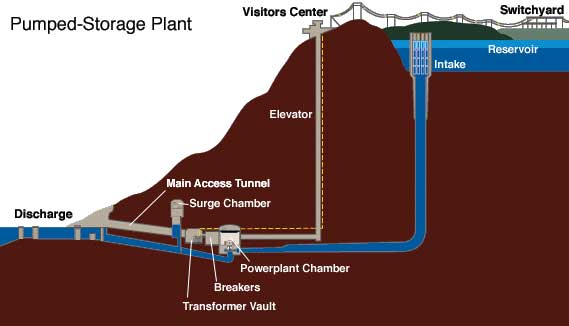
      Pumped storage between dams (or cisterns) of different hight is 90% efficient but the greens wont allow more dams.
      http://en.wikipedia.org/wiki/Pumped-storage_hydroelectricity

       Its particularly effective if wind and solar drive water pumps directly since both are more efficient at pumping at low wind and on dim days.
      Hydrogen is a viable technology too if your not trying to make it for transport. Hydrogen electrolysis is 80% efficient. The inefficiency often cited occurs where your then liquefying the gas, that's very inefficient.
      If you store the gas in a simple 18th century gasometer it would be cheap and sustainable grid storage particularly if the hydrogen is plumbed into a conventional coal fired power station.
      Yet no government has backed such a simple technology and the greens might oppose the gasometer's.

      Compressed air storage is also viable, 2 working plants at the large scale and several at the micro/ house hold scale,  but because its 130 year old technology you can't get a patent and capital markets are not interested if the solution is not exclusive. To do 10000 compressed air systems you need at least 100 companies.

      Exclusivity is the problem. World War one destroyed exclusivity in the fossil fuel game; we ended up with hundreds of companies in the game beaching each others patents willy nilly.

      When governments say their trying everything please remember its always a lie.

      In order to make this viable you also need a price differential between the makers of energy and the price of energy at the house hold or factory meter.  There needs to be a peak and off peak differential at the energy producer not the energy consumer. This margin allows the grid storage companies to buy low and sell higher into the peak demand. If renewables are paid the same price per watt regardless of their reliability there is no margin for the grid storage companies. They can't capitalise the needed technology. If Solar is subsidised without consideration for demand patterns and the need for grid storage the result is a negative margin blocking grid storage altogether.

      Some in the renewable industries reject base load energy  and the need to match generation to demand patterns. Yes it is possible to change demand patterns a little but these things are often locked into how all societies work. No society has been able to change them significantly. If grid storage is properly priced into a grid then there is less profit for intermittent energy producers like solar. However without grid storage these energy technologies are not viable beyond 6% of grid capacity.
      Generally grid storage should make renewables viable and reliable and therefore profitable. It should be profitable. If allowed, not encouraged just allowed, it should make a solar wind system viable as a response to real or perceived energy scarcity.

      Friday, February 04, 2011

      Torture is never simple.

      Why do we believe the claims of torture and oppression on the part of Mubarak's regime? The same people claim Israel, America and even Australia tortures Moslem. We know that's not true in our case, Australia, so why believe it in the other cases. Mosab Hassan Yousef in his book Son of Hamas showed that half of the torture in Israeli prisons is from scared Jewish conscripts and half is Palestinian on Palestinian abuse in search of Israeli informants or because some prisoner is not in the right faction. Is it the same in Egypt? In the Palestinian case the prisoners tortured by other prisoners invariable protect themselves and their families by blaming the Israeli government for the scars and missing fingernails.

      In vietnam the vietcong infiltrated the south vietnamese police, military and interlegence services. Some of the most fanatical and ruthless members of the south vietnamese forces turned out to be north vietnamese deep cover agents. To be ruthless in the name of the state you've infiltrated is a powerful propaganda tool. It allows you to expand attacks onto neutral targets.

      http://en.wikipedia.org/wiki/Phan_Th%E1%BB%8B_Kim_Ph%C3%BAc
       The wikipedia give the official cover story of the time. Blaming the pilots.
            You know that this image did more to win the war for the North Vietnamese than any other. What you did not know in the 1970's that it was a strike with napalm by South Vietnamese air crews on a civilian villagers and south Vietnamese troops well inside South Vietnamese lines and that it was caused by a North Vietnamese double agent who is believed to have switched the target coordinates and confined the target when the pilots were doubtful. The officer is now retired on a North Vietnamese army pension.

      How much of this sort of thing is going on in Egypt. How many of the Egyptian police and military are Moslem Brotherhood deep cover agents.

      Mubarak may be a despot but if he was as ruthless as they claim I would have expected Tahrir square to be knee deep in bodies by now; thousands dead in minutes. We don't see this! We see Mubarak moderating his actions at least in front of the camera. He is doing what many governments in the west would do, have done, in such emergencies. Muddled and botched attempts at law and order in the face of chaos. Not much different from Katrina or the French response to Moslem riots in the outer suburbs of Paris. We have only 6 officially dead and 900 wounded. We don't know what proportion of those are Mubarak supporters. We see the left wing anti-mubarak media under attack from Mubarak supporters. However would these western reporters be able to tell if they are being attacked by Mubarak supporters or moslem brotherhood fanatics playing both sides. Its only the translators words they understand.

      Remember the tea party marches in Washington, the few left wing reporters that bothered to show up made similar claims of pushing and shoving. Some of that was true.

      I think Mubarak should, and will, go soon. I don't think democracy will result. The world, particularly the western media are overdosing on naivety. The so called secular moderates that started this battle are no longer in control. Their hit and run protests of the first few days replaced with a very old fashion massive last stand in a public square. A very Islamic last stand at that starting with prayers. 
      An islamist dictator will arise, perhaps with a sham democracy as cover for a while. Remember Hitler was elected in a democracy.

      Thursday, November 04, 2010

      A post Federal Reserve Bank World

      The worlds banking system is in crisis. The Keynesian paradigm of fiat money and fractional reserve banking is dying. It has always failed but this time its smoke and mirrors tricks have failed to. They have printed too much money and broken the system.
      If they end the FED then what do we do?
      What does a post FED world look like. 


      The key to an alternative is two conditions. 1. Open entry, anyone can make money but no one is obligated to accept it. and 2. Enforcement of contracts, no one can make false claims about or fraudulent valuations of their money. I might add a third: Public and media based testing and checking of these money's and contracts.
      Assuming other central banks are also eliminated in the process.

      1. Gold and silver currencies in many competing forms:
      a. Gold backed electronic money for large and web transactions,This can now be done with bitcoin and ripple systems.
      b. Gram weight metal in plastic cases that work like coins or credit cards I.E. Shire Silver,
      c. Ounce weight metal barter coins,
      d. Nickel and copper coins with a contractual valuation in gold or silver. Not both.
      e. Large Dollar silver coins with a contractual value in silver and a embedded computer and screen that lists the current gold /silver value ratio.
      In most places one currency with predominate with machines accepting other currencies and giving the local favoured currency.

      2. Full reserve* banks with fewer offices but more digital and video phone to real staff interfaces. Several types of savings:
      a. Target savings accounts. Money is not available on demand until the target is achieved. (I remember these from my youth.)
      b. Term deposits with two days notice to withdraw. Mostly invested in mortgages and commercial loans.
      c. Direct bond sales via the banks interface (computer, phone or auto-teller) with a receipt. These bonds do not pay annually, they are true bonds. This avoids borrowing short to cover long liabilities. You know for sure you have the bond. Bank holds the bond until you request it.
      d. Credit and debit cards with small fees, higher but sustainable interest on the credit, none on the debit and higher default fees.
      * It is possible to have contract based fractional reserve banks but these would need to recall and extinguish their note and contracts each time they lower their reserve provisions. These would be much higher risk but fee free.

      3. Many more mutual funds. Operating as above.

      4. Automatic digital transfer of remaining accounts from failed banks to other banks that the first bank must pre-nominate and contract with. Any remaining assets are transferred with the accounts. This eliminates bank runs and is largely the norm today but the accounts go to the biggest 5 creating the to big to fail problem. The system needs to spread transferred accounts more widely. The banks share holders take a full remaining loss. That'll teach them to avoid real-estate and other bubbles.

      5. More peer to peer lending with legislation ensuring that the contracts are clear with no fine print. Defaulters get banned and get a poor rating that goes global across networks. This is unsecured lending but as the mortgage derivative debacle taught us, Banks don't always adequately secure the loans.

      6. A law change so that companies can sell shares and micro shares via a web application or digital broker on their web site with another site handling resale's. No minimum limit on the size of a share sale thanks to digital tracking. The current limits, minimum share issues and brokerage practices are tied to out of date methods and paperwork systems.

      7. Microshares are for very small web businesses with valuations in the fractions of a cent or via a virtual currency like SL Linden. Essentially the micro-transactions that were promised in the dot Com boom but got blocked by government meddling. Hence the bust.

      8. Many charities will use targeted fund-raising with things like Indiegogo, Kickstarter and other crowd funding agencies. Assurance contracts and particularly Dominant Assurance Contracts can fund most public goods and could subsidise access for the genuine needy to private user-pays goods and services.

      9. Law changes so some charities will sell bonds. The interest on the bond goes to the charity with the Donor retaining the ownership of the principle. He/she may choose to donate the principle fully to the charity after a time. This creates a permanent predictable interest based income for the charity to match on going needs and avoid fluctuations in donations. (Note: Not all charities today can invest donations long term. They must spend as they go; creating short term cash flow problems and thus a long term stability problem.)

      Some of these solutions were not available before 1914 and therefore we can't talk of going back. New technologies eliminate some of the excuses for fractional reserve banking and fiat currency. They don't eliminate the bankers desire for a cartel that blocks out new players or gets government to cover their losses but it makes it harder if we take away their excuses.
      It also wont eliminate the governments desire to spend beyond their means but again it eliminates the currency excuses. The new charity solutions and crowd funded public goods further reduce the need for government services which is why I list them.

      Interest rates would be higher, Rarely going below 6%, Mortgages would match this limit. Some long term interest would be 3%. Most shops would have tools to check coins and web linked digital signs to up date everyone on the current ratio of the available currencies. Currency values would be stable overtime and productivity would be high 5 - 8 % but not spectacular. Spectacular GDP is be mostly fake where encountered. The exception would be rapidly developing new third world communities and space colonies.

      It will be a very different world where we learn to judge money as a product and check its price and exchange rate as we go. Most shops will have tools help people in the transition. Your money will be safer than it is today allowing peoples plan to be fulfilled and not confused by government meddling.

      Thursday, October 28, 2010

      Building the first generation of buildings on Mars.

      The initial exploration of Mars will be in Mars habitats sent from the earth.

      An early mars hab. Mars society. 
      Search mar hab for more. 
      However there would in all likelyhood only be four or five such missions. Once a good site is found with the prerequisites for colonisation a real base would be built from mostly Martian materials. Those prerequisites are a deposit of water ice or underground water, Iron or Aluminium ore, good rock for building or aggregate production and some nitrates.

      Then an industrial module or two with the capacity to make structural materials would be sent to the colony site. Carbon fibre and carbon composites may prove cheaper and easier that metals. Carbon dioxide provides abundant carbon. Plastics can be made from CO2. 

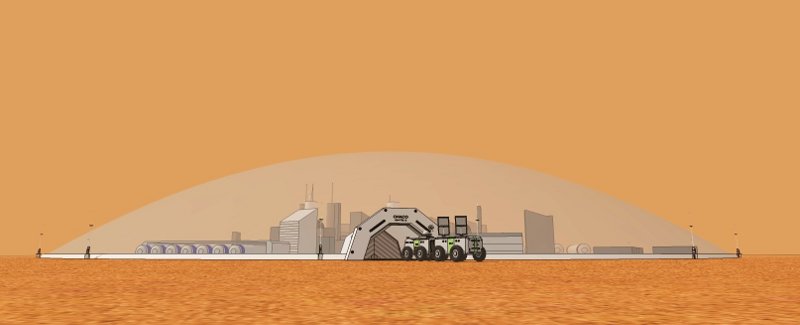
      So the question is what structure to build? Most think domes but domes have their disadvantages.

      Image from http://orig08.deviantart.net/cbf0/f/2010/176/b/4/mars_dome_01_by_ludo38.jpg
      Domes have lots of round corners that boxy furniture and things don't fit into, Its hard to stack radiation shielding in a dome and you need some shielding to shut out the natural cosmic ray flux on mars. 

      There is another little known problem: While Mars is cold the structure will have a lot of heat sources inside it so there will be a heat dissipation problem. Domes are good at keeping heat in due to their low surface area to volume ratio. A box is good for getting rid of that heat without expensive equipment. It has more surface and one face is always in shade.

      I believe the best early first generation buildings will be multi-story box like structures. Like this:
      This structure has several advantages. Most surfaces are rectilinear so replacing panels and windows is easy. There are ample windows for natural Martian light to enter. There are views of the farm domes and the landscape beyond. Reducing any claustrophobia risks.  
      The Martian radiation flux is cosmic rays so its a vertical flux. As a consequence only the roof needs to be shielded. If you make the building multi-story then one square meter of shielding shelters many square meters of living space. The shielding would be just rock or gravel, ~2-3 tons per square meter of roof. Far more than most domes could handle. The main structure would be reinforced concrete or reinforces polymer bonded aggregate with carbon fibre or iron reinforcing.
      This structure has several other features.
      Viewed from above you can see that the buildings stand on a central base,or shared ground floor, that allows shirt sleeves access from section to section. The buildings are segregated so if there is any pressure breach or fire in any building people can escape to the other sections. Behind the building are several tanks for spare oxygen and other chemicals that are kept clear of the main structure for safety and temperature control. The greenhouses are less shielded because plants are less vulnerable to this radiation.

      If you really like domes you can add them;


      You could even add playing fields etc in them:

      In the above structure we have a playing field. Short exposures to the cosmic ray flux is safe; it happens to you every time you fly on the earth. This sports dome doubles as a place to stitch together large plastic pressure structures. The brown boxes in the fore ground are chemical and heavy industrial plant units segregated from the main structure for safety reasons. To the side you have a mine and on the left in the distance you have the spaceport with its big white fuel tanks.

      This Mars base has several kinds of farming. The university dome in the fore ground has planters and grasses on any available area to feed people and animals. This includes planting on the roof tops. Most activities are indoors within the buildings. The elliptical domes hold fields for grains, pulses and vegetables. There is a multi-story vertical farm behind the university with hydroponic and airponic fruit and vegetables. Most people and some livestock live in the three remaining tall buildings. Some things will be boringly the same as on earth; there is a cell phone tower on the ridge behind the buildings.

      These structures would be built unpressurised. With pressure tight balloon like structures added to each floor and pressurised double glazed widows added to the out side. This gives the structures emergency redundancy. Essentially a plastic balloon in a box with internal panelling protecting the pressure balloon from knocks and wear and an outer shell to keep the sharp Martian dust away. 


      Eventually another technology will be used where suitable. These are low world houses. Roofed valleys with normal looking farms and suburbs. That however is many decades away. 

      I've written on low world houses here:

      It may be possible to terraform Mars but these technologies will make it habitable without much fuss.
      Most of my illustrations are done partly in Second Life and worked up in gimp. Some were on display within Second Life but sadly that Space Destiny's sim is now gone.

      Wednesday, October 27, 2010

      Banked track Magnetic levitation based artificial gravity

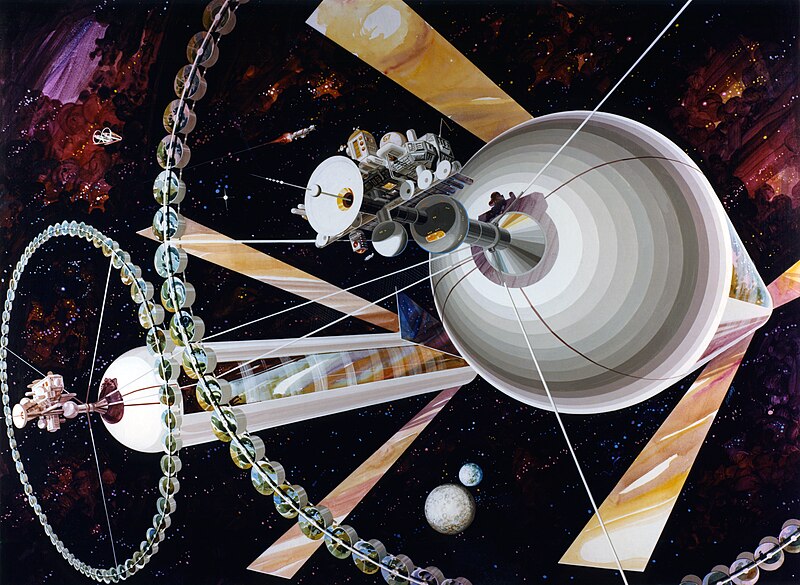
      We can make space station that simulate the earth's gravity using centrifugal force. Generally for maximum comfort the centrifuge needs to be limited to 1 RPM and that leads to a diameter of about a mile (1.6 km). These are thus very big structures with a lot of material mass. OK in the zero gravity of space but you can't stand one on end on the moon.

      Image: http://en.wikipedia.org/wiki/File:Spacecolony1.jpg
      There is a way to put a centrifuge on the moon or an asteroid. This is to use basic railway technology to create centrifugal gravity. The centrifuge is a train with multiple carriages running around a track 1.6 km in diameter and as close to perfectly circular as possible. Either the track is banked or the carriages are built at an angle so that the centrifugal forces combine with the low gravity of the moon or planetoid to produce approximately one g.
      The blue is the track with a large dome adjacent to it for low gravity recreation and some food and oxygen production. The Dome is stadium sized.

      Each carriage would be as spacious as a large train carriage. Some would be gyms for maintaining muscle tone and bone density by exercising in normal earth gravity. Some would be medical and maternity facilities to ensure normal recovery and normal pregnancies. Some would have apartments and hotel suites. In a well established base there may even be livestock stabled in some carriages.

      Luna 7 Tracked centrifuge and ancillary buildings and domes. Most structures are deep underground in the lava tube network. 

      Unlike a larger space station the train stops regularly to allow people to come and go. Warnings are given so none are caught out. Many internal structures are designed with a radical change of orientation. The direction of down changes through 60-90 degrees.
      To generate one earth gravity the train must run at 239 kph an easy speed for magnetic levitation technology in vacuum or a thin atmosphere. Stopping and starting takes several minutes so there is time to find all the loose things lying around that may fall.
      This small pioneer carriage is designed for the starting crew. Its orientation goes from this normal running orientation above to:
           
      This orientation when stopped. There is a possibility that the table and counter top might tilt. This model was in Second Life. The crew sit in a lounge near the table not on the blue seats. there is provision for standing at odd angles in the shower behind the floral screen, in the toilet opposite and beside the camera (Note: in the top hab image you see a grey/ white deck with the writing on it and the green box. I'm standing on the box in the second image. Select the box and stand ).
      The counter top has a kitchen bowl that is clam shell shaped. Thus it retains the water regardless of orientation. A spar bath in the gym would be the same only much larger.

      The first unit on the moon however would be small as the second life representation of a small habitat shows. It has three bunks, a tread mill for muscle and bone fitness and would be on an above ground track. A separate solar flare shelter would be near the track or one section of the track would be covered.
      A full sized flat car would look more like a luxury railway car.
       
      Image made with gimp from google images of search "railway luxury carriage"
      Larger cars or carriages are possible. Below are two 6 story cars with the external shell removed from the front one.  This has a garden with trees and a 4 story building. It has two connectors front and back. One for people [blue] and one for freight and through traffic [red]. The shell would be pressure tight with artificial lighting and view illusions, Trompe-l'Å“il, probably digital and changeable. These could be farms or offices instead of homes. [Track not shown.]
      These larger cars would not stop normally. Passenger transfer is by smaller cars running parallel on a track beside or under the main track.
       Zero g.
      This technology is not just useful on the moon. There it allows large long term human population to live normally. The technology could be used on asteroids. There the gravity is so low that you don't need spare floors at strange angles. As the train slows down to a stop the gravity drops to zero. Your wash basin needs a lid not just a funny shape.
      On this Asteroid we have two magnetic levitation train lines, yellow rings, as well as some domes for zero g gardening and several cylindrical building for zero g recreation and manufacturing, etc. the Black structure on the back of the asteroid is a solar furnace for power and metals smelting. The green domes are lit by free floating mirrors behind the camera. This asteroid could support 10000 people.

      I've also designed a free flying space station. This has the lowest mass to crew ratio of any design with centrifugal gravity.
      The twin trains run in opposite directions within the yellow ring. This is shielded with water tanks, storage spaces and space slag. The Sphere has a double geodesic shell with water in the gap for shielding and thermal control. The internal spheres are farms with shielded stowage for zero g planters. The geodesic spheres entire volume is pressurised as a large zero g recreational habitat.

      The large dark thing on the right is a solar shield. This reflects the suns radiation away, provides some radiation shielding and a safe place for ships to dock. The station and the shield are linked by a pressurised cable car and perhaps a few long torsion spars. Sun light is provided by a steerable free flying mirror that give controllable day length and temperature control (black ellipse above. Your seeing the back of the mirror ). This structure would support 5000 people with some farming or gardening in the carriages and smaller centrifuges.

      Here's another design. This unit might support 3000 people. It would have the same shield and mirror technology as the sphere. 

      Most people don't know that plants have been grown successfully in zero g on the various space stations. Plants like gravity but a few days as a seedling in a small fast centrifuge will suffice. Plants don't get dizzy.

                                Plants on the International space station.

      In case your worried about radiation hazards all the banked track systems on the moon, asteroids and space-stations are either burred in the ground or armoured with a high mass non-rotating shell around the track itself. There would be provision to move planter pots and whole garden beds into shelters under the domes and inside larger solid structures.

      This technology will allow people living in space to have gravity when they need it and zero g for fun and research. Short exposures to normal gravity daily prevent bone calcium loss. By designing the cars to be used for about half the day time hours would suffice. Short periods of zero gravity should not harm anyone including embryos. Though that needs to be checked.

      While these space stations will never look like a chunk of earth transplanted into space, like the illustration below, they will be adequate and interesting.
      Image: http://en.wikipedia.org/wiki/File:Spacecolony3edit.jpeg

       First illustration, the luxury train cars and the one above are from the web. The Third illustration is pure gimp and relatively new. The large multi-story car is sketch up. All other illustrations created in Second Life with some reworking in Gimp. Sorry the hab photo's are so dark. I stuffed up with the virtual camera. Lol.
      Sadly nothing lasts forever even in cyberspace and Space Destiny sim in Second Life with all my work is now gone. When a sim closes the prims are meant to shoot back to your player inventory but it simply could not handle 3600+ prims!
      I'm Wesley Farspire in Second Life but bigger worlds call me away most of the time.

      Saturday, October 02, 2010

      13 things that will boom if oil goes to A$7 liter or $25 a gal

      These things will boom and will be quickly organised via the web and social networks if something pushes oil to disastrously higher levels. A war in the middle East would raise prices as might the collapse of our currencies by high or hyper-inflation. 

      1. Car pooling with 'fares' paid to cover the fuel. Governments may try to block these in defence of taxi regulation but will be laughed out of court.

      2. Conversion kits and businesses that covert cars to LNG.

      3. Conversion kits that turn an older car into an electric. Licensing barriers will be blown away quickly. Already legal in Australia and some US states.

      4. Conversion to ethanol. Only 400 dollars. Big ethanol may be non-viable but there are those working on smaller stills and more sustainable ethanol. All the red tape imposed today will be bypassed by some cities best placed for ethanol.

      5. Mopeds, scooters, motor units that convert your push bike into a moped. If your cities got warm winters or a tropical climate then these will boom; particularity in flat cities with intermediate distances and only one hill climb.

      6. Bus companies that buck the system raise fares to cover the rise in diesel and offer free or cheap pensioner fares only in off peak periods. This will be particularly powerful if these are LNG buses. LNG wont rise as fast.

      7. House swapping web sites. These minimise the cost of moving, finding a house without paying a real-estate middle man, swapping the papers without paying anything but the perceived value difference and taxes. Most governments facilitate swapping of government rentals but this will be mortgage for mortgage with desperation shortening the haggling.

      8. Suburban micro-office. A house or shop converted into office space for 10-20 people. This creates a workplace away from the kids and the distractions of home and with the amenities of an office: broadband, fax, a big copier/printer complex. A centralised business hires a desk or cluster of desks for a month or so for its staff that live in that suburb. All staff work there 5 days a week commuting to the central office in the 'company carpool or minibus' as required but no more than twice a week. This gets people out of the house and into an office but their still in the suburbs. Team building will require some grasp of geography.

      9. Company buses. Industrial companies, early in the crisis, will hire or charter private buses to go to a hub in the suburbs; Everyone working for the company will be instructed to walk or ride to the suburban hub.

      10. Every church, old peoples home, NGO with a small to medium bus or large vans will go to work ferrying a few people from their congregation or neighbourhood to the nearest rail hub. The buses will fill. There will instantly be a thousand 'donations at the door bus services' using these generally underutilised mini-buses. Donations will exceed the fuel cost quickly.

      11. Bus trams will be deployed in many cities. These are normal buses with capacitors in their hybrid or electric power train. At most stops there are overhead wires that a pantograph links to for quick a charge while people are boarding. There are no overhead wires on the roads its only at main stops and some traffic lights. This is the cheapest new alternative to light rail and it can be quickly deployed. http://gas2.org/2009/10/21/electric-ultracapacitor-buses-becoming-more-feasible/ and at the shanghai expo this design is in use. http://212.181.8.238/webbplatser/vbeb/archive/2009/12/15/sunwin-super-cap-bus.aspx The ultra-capacitor technology is in free fall prices wise; one system uses flywheels that are even cheaper.

      12. Some families will adopt the strategy of taking the whole family to work in the city. With schools chosen for their proximity to work not home. Tea time will be at a restaurant or in the office cafe. The trip home will be later in the evening taking advantage of cheaper off peak buses and trains. In some third world countries where the price of oil is already beyond them this is often done.

      13. One from dear old Fidel Castro's Cuba. A semiprivate company has designed a 'bus' that attaches to an 18 wheeler tractor. http://business.fullerton.edu/management/slpurkiss/images/truck-bus.JPG These are called camel buses. Cheap and nasty but with a little smarts, intercom for safety and cameras so the driver can see all round the vehicle these will deploy by the thousands. Off peak the tractor does other work. Actually quite smart. http://en.wikipedia.org/wiki/Trailer_bus


      All of these solutions can be quickly deployed. All have potential problems with rip off Merchants,fraud and government red tape. Struggling city councils will shred the red tape after the first city that resists the changes dies. In some cases the Greenhouse scare has paved the way with red tape disposal and facilitation developing in response to CO2. To some extent people forget that there was suburbia before the car became cheap and ubiquitous.

      Monday, September 20, 2010

      Cellulosic Starch. - biotechnology challenge.

      Cellulosic Starch would be the one technology that would go further to feeding the next three billion people than any other biotechnology. There is as far as I know no work being done on it.
      The key is to take the same cellulose breaking enzymes that turn straw into sugar for ethanol production and use them to make food grade glucose most of which would then be made into starch with another enzyme.
      We can grow grass, straw and jungle leaves from the high Arctic to the deserts and on to the equator. We can grow much more cellulose than grain in the same field. Planting and harvest is closer together and the crop of grass can be perennial.
      The cellular processes that turn glucose into starch is not yet fully understood. We need to identify the key cellular processes in edible plants, publicise the need so private, commercial or charitable funding can be found.
      A team needs to be created.
      The final desirable product would be a machine sized for a first world farm or third world village that can do the following steps.
      • Pre test the plant matter for toxic contamination. This may include a slow conveyor that allows the plant matter to be visually checked for obvious contamination dirt, plants and animal material. 
      • Mill and break down the cellulose into glucose or sucrose in sterile water through the action of the enzyme.
      • Sterilise or filter out the enzyme. 
      • Filter-out any non digested cellulose, lignite, plant oils and other extraneous non sugars.
      • Possibly, concentrate the sugars recycling the water. 
      • Synthesise edible starch from the sugars. Perhaps using a naked enzyme or an engineered glucose feeding starch cell culture. 
      • Remove the enzyme or plant hormones that make that work. 
      • Dry and package in a storable form. 
      • Test for contaminants, spoiling or other problems. This should be concurrent with each step. 
      • Regenerate waters filters, testing gear, etc.
      • Produce more bulk enzyme and plant hormone or plant starch cell cultures. 
      We should ensure that the taste is not influenced much by the taste of the feed stock. A bland flavourless starch is best. Some of the glucose can be retained for sweetening. Some can be used with other value added cell cultures to produce proteins such as gluten, lysine, Guanine, etc. These would need to be carefully labelled since some people can't eat gluten.

      If we can make such a technology then we can harvest grasses and other fast growing plants and turn that into starch. Then using a mix of the raw plant material and the starch we can feed livestock for protein: eggs, milk and meat.
      Because hay and straw can be stored for months and years; areas with short growing season and long droughts can feed many more people.

      Ideally the technology should be cheap enough to sell in the third world. Financing arrangements would be needed for both the research phase, the third world deployment phase and the follow up maintenance phases.

      While the starch will compete with normal starch crops it will augment their availability not replace them. As world population grows those industrial applications for bulk starch will switch from food grade starch to cellulosic starch freeing up more edible starch. Food grade cellulosic starch would fend off famine in the developing world. There are ethics questions to be asked and they should be asked early but I can't see how a categorical no would make sense.
      It wont solve all humanities problems but it will feed many people.

      Up Date: Someone's cracked it.
      http://www.gizmag.com/cellulose-starch-food-plants/27175/
      Brilliant. Percival Zhang and his team managed to do it in a single step enzymatic process.

      Monday, September 13, 2010

      Game changers in war. The technology of free market defence.


      Minute man 2020. Game changers.
      Robert Murphy has looked at free market defence. 
      http://mises.org/store/Chaos-Theory-P190.aspx
      It can be argued that a free market system guided by the profit and loss system would make use of a slightly different set of weapons.
      Some weapons that a libertarian society might prefer can be predicted. Nuclear weapons are out; cheap weapons that save lives even enemy lives are in. Weapons that minimise property damage make better sense than bombs.
      Here's 25 links and some notes. Note this technology is not in the Bob's book its the logical choice of a private defence entity. 

      Infantry - Armour, ballistic shields for the light infantry. Some solutions are simple.
      One company is designing a ballistic apron but will soldiers wear it if they look like a butcher? This ones for factory workers but its the same technology.
      For the elite specialists.
      The biggest factor will be at the building design level. If a society takes on the challenge of defending its self rather than leaving it to the government they will build different kinds of buildings. A common feature of Israeli housing developments since the katyusha rocket attacks of the second Lebanon war (2006) has been to build bunkers in housing complexes.   

      Gear and supply's too heavy? Try a pair of robot legs.
      or 4 robot legs. Big dog.
      or errr just watch this after the one above. I couldn't resist neither could the researchers.

      Intel is essential, particularly in urban warfare. Thrown cameras help. The Israelis are way a head on this stuff. Micro drones may supersede these. A soldier could carry several of either.

      Or send in this little fellow. One version has a gun.

      Want to fight at lower risk.
      Corner shot. Now being used yet still new. This will save many civilians who get caught up in a fight and get hit because an exposed fighter can't risk a second glance.

      In an ambush context this will take them down without killing them.

      For the heavy hit.
      Sniper bus rounds. A grenade launcher with the range of a sniper rifle.

      If all else fails send this guy in. Its only CGI but all the hardware exists except power supply.

      Armoured corps – Tanks are useful for retaking territory the enemy has taken and for defending open farmland, desert and plains. Fixed defences are sitting ducks in the GPS age.
      The future light tank will be armed with sensor drones to check for mines and ambush ahead. It will fire smaller calibre but more versatile rounds. It may deploy ground robots as it main weapon system rather than a turret or APC infantry. It will be expensive but we will only need a few not thousands. Air-mobility will still matter. The enemy will try to cut units off.
      However a free market society may not want to telegraph its punches or attract the ire of foes by deploying a tank. It may use something like the Rhino Runner. With digital ink advertising and a little cheap camouflage this could drive past you and you would not know it was an armoured vehicle.
      Yet this could carry dozens of troops, robots, or an entire swarm drone command centre and drones. A truck version would look like a civilian truck. http://www.armored-trucks.com/

      Robotic cars are also off the drawing board and may be 3 to 6 years away. In an emergency these robot taxi's could be sent in to rescue people where a driver may fear to go. They can deliver supplies or could be sent in to create an automated traffic jam around the enemies convoy.
      or this Wikipedia page, Its a little out of date.

      Militia air-force and intelligence. -
      Coffee cup sized flying Swarm robots. These gather intelligence and can hunt down foes. Their down playing the attack function in the video. It can be lethal or non lethal. A swarm of 30 could take down a squad of infantry in seconds. This scares even governments because at $200 a robot, half the population of a free city or enclave could own one. By 2020 the sophisticated communications technology to control these at long range will be in civilian hands. New power systems means they will be silent unlike the whining toys of today.
      One prototype.

      If you need more hiting power.

      Getting gear where its needed.
      and


      Navy.
      Have a coast line or sea stead to protect? 10 of these can cover 50 miles of coast for the cost of a patrol boat. Add some micro drones and they can inspect vessels.

      Robotic submersibles loitering on the coast provides underwater coverage. Set them up with a sea bed charging station or battery swap system for long endurance. Neptune Canada is a seabed sensor network with a robot sub based on the sea bed. Its for oceanographic studies but the technology could be adapted to "own the sea".

      Most of the strife of naval war is about getting cargo and fuel in and out through blockades. Cargo-submarines has always been a good answer but for some reason never used by the good guys.
      What they can't see they can't stop. Ports need camouflaged sub pens.

      All of these systems are an order of magnitude cheaper than the alternatives. They are all force multipliers and reduce casualties and soldier training requirements. You don't have to be fit to control a drone from your lounge, office or bomb shelter. Because of communications and intelligence limitations they favour defensive operations. Yet in combination some can deliver a strategic strike capability (non nuclear) where needed.


      Thursday, August 26, 2010

      The challenge of a green controlled Senate.

      If Tony Abbott forms a government in Australia the greens and labor in the senate can block supply but that will cost them at the subsequent vote particularly if the liberal party is putting up all the No Regrets options from the Garnaut report and other clearly sensible options. MP Bob Katter will oppose the ETS and he seems to influence the other two country independents on that a little.

      To counter the green balance of power we need someone to go "full metal climate sceptic" in the senate and get into Hansard all the sceptics arguments.
      http://surfacestations.org/ 80% station wrong with a 30% effect on warming signal. That means that the detected warming is not +0.6 its +0.4. and it disapeared altogether in the mid 1990's due to changes in solar activity.

      The missing M's http://wattsupwiththat.com/2010/04/17/giss-metar-dial-m-for-missing-minus-signs-its-worse-than-we-thought/

      The fact that some old records have been adusted down to make the 21st chentury look wormer than the early 20th century.
      http://wattsupwiththat.com/2010/02/26/contribution-of-ushcn-and-giss-bias-in-long-term-temperature-records-for-a-well-sited-rural-weather-station/

      Cloud based negative feed backs are being discovered and confirmed.
      http://wattsupwiththat.com/2009/06/14/the-thermostat-hypothesis/
      and
      http://wattsupwiththat.com/2009/07/23/new-paper-from-lindzen/
      This second paper is believed to have triggered off the whistle blower at the CRU.

      The fact that the system of carbon reduction scheme were so sloppy that people have been ripping the system off by making CFC's and the destroying them. http://joannenova.com.au/2010/08/corruption-for-dinner-anyone-the-carbon-market-scandal/

      And the fact that the two climate exchanges have crashed to the floor and are laying off staff. http://www.reuters.com/article/idUSLDE6791WI20100811
      The floor in Chicago is 10 cents. The European markets floor is 15 EU. http://www.chicagoclimatex.com/
      No demand means even Al Gore isn't playing the market any more.

      Monday, August 09, 2010

      Could Iran kill off Palestine? The danger no-one sees.

      Most people that talk about Iran's nuclear threat to Israel argue that Israel is a small country, a tiny target, one nuke would do it! This is said with fear on one side and evil intentions on the other.
      However a tiny target is a tiny target. It may prove hard to hit. The Iranian missiles are not renowned to their accuracy. If the bombs to big or delicate for the missile then the attack must come by air, land or sea. Israel intercepts boats a hundred of miles off shore, It has agents and drones watching the roads to its boarder. It probably has ground routes 'bugged' with Geiger counters. I know I would. It may even have these defences forward deployed at the Jordanian border with Syria, Iraq and Saudi Arabia. The Saudis may now have such nuclear bomb detectors deployed on their own borders and ports given that Riyadh is the other most named target of Iran.

      Being a small target will mean that if a missile or bomber from Iran misses long it hits Gaza or the Mediterranean. If it drops short it might hit the west bank or Amman Jordan. Miss to the north and you kill a lot of Lebanese. Miss south and you kill off the Egyptian Bedouin. Any strike near a border will kill UN personnel.
        
      If Iran hits Israel it will kill off Palestine totally. Atomic bombs produce fall out plumes that can have a radius of 20 to 50 kilometre and persist for days.
      The Zionist radicals have NBC and know how tho used them. They reportedly have Geiger counters in their cars. The moderate Zionists have radical Zionist relatives. Both will be in the bunkers within minutes. Only a few will die.

      The Labor vote, the Israeli Arabs and 'peace now' Israelis have junk in their bunkers, limited NBC and at best only think they face Katyusha. They will die in their bunkers thinking they should have read the instructions earlier.

      The Palestinians don't have bunkers or NBC and will die in the streets by the million or die fighting for any building they think might work as a bunker. Tens of thousands will flee into neighbouring countries.

      Some in Palestine will survive. These are the hidden pro-Israel Palestinians; Arab Zionists. I suspect they have acquired good NBC from friends in the settlements. There's less than a thousand of them. A few Palestinians will survive because their deep in Israeli prison cells.

      All this assumes no Israeli violence in revenge. I think that unlikely but they may be too busy to lash out.
      When the fallout settles and becomes safe the Zionists will be the majority among the angry survivors and one in a hundred Palestinians will be alive to curse Iran. 'Ahmadinejad' in Iran is the most dangerous threat that Palestine faces.

      Thursday, August 05, 2010

      Old Green lament

      I was once a proud green before the watermelons took over. Many greens are genuinely concerned about real environmental issues but the education system has taught them that the only solution is government, taxes and removing humanity from the ecosystem. 'Reducing the human impact.' 

      The old idea that there might be free market solutions to these problems is totally alien to them. If David Holmgren and Bill Mollison were trying to kick off Permaculture today the greens would be their major opponents. They would be classed as greenwash. Some of the older greens in the 1970 were Christian conservatives and anti-homosexual. One was still helping with organic farming field studies in the 1990's and got in fights with lesbian students.

      Some greens are disillusioned humanists, past technophiles who thought green technology would solve all things. They have seen the failure of the technology they love. They have become semi-Luddite rejecting technology as technofixes. It really wasn't the technologies that failed but the big government and subsidies approach to deploying it.

      There is good news to be had. Some greens are becoming active out side the green movement like Bjorn Lomborg. Others are linking up with the liberal party, etc.
      And best of all when more that 4 greens get into a Parliament they tend to split on things a lot. Giving them some power is the most effective way to destroy them. 

      Or at least force them to realise that you can't save the world by ending civilisation and modernity in all its forms. 

      Tuesday, July 13, 2010

      Saving the World by burying the Greens.

      In medieval Europe many cathedrals and churches were built with money from people that paid for crypt spaces and burial spaces in the building or its grounds.

      What's the equivalent today? For many nature is sacred so lets give them their eco-cathedrals.

      Why have grave plot in the big city costing many thousands of dollars if you could have a hectare plot in the wilderness? Grave plots are getting very expensive. Even getting a hole in a memorial wall for grannies ashes is very costly. However land in the country side is very cheap particularly if its non arable land. Even arable land in the country is only a few hundred dollars a hectare at most. A green funeral plan could be created where an hectare, half hectare or quarter acre plot is purchased in an ecologically useful location. A grave plot or two are set out and the rest restored to wilderness.

      Wilderness can be created by skilled landscapers, botanists, entomologists and zoologists. It need not be fenced but it may be wise to fence out feral animals: introduced predators like the cats, foxes in Australia, possums, goats and pigs in Oceania. Trees are planted if necessary and bird boxes, artificial nesting sites created. Hollow logs are created and deployed. Ponds may be added to encourage frogs and water the fauna. Ideally the memorial nature parks should be located to create fauna corridors and buffer zones around fragile areas.
      Some consideration is needed on the provision of fire brakes, fire shelters, road crossings for both ground fauna, aquatic fauna and arboreal animals.

      Only part of the money is spent on immediate costs land purchase, landscaping and the burial. The rest becomes a memorial trust invested carefully with some investment in gold and some compounded. This grows the fund, the gold protects against a crash, it provides the economy with a long term investor to match some long term borrowers.
      The interest is used in two ways:

      Firstly, If the funeral is not immediate they pay for the funeral its self. Funeral costs should be kept under half the interest funds if possible.

      Secondly, It is used to fund on going long term management of the this and the other memorial nature parks. Care must be given to remove invasive weeds, non indigenous plants and feral predators and browsers. The principal should not be spent if possible.

      When the buyer of the plot dies they are buried in the burial plot. Early purchase means the ecosystem becomes a wonderful back drop for an out door ceremony. To be viable the total cost, including the seed money for the trust, should be less than the urban burial plot.

      Some consideration is need in the design phase of the burial location to the effects of the burial itself on the ecosystem. The impact and space required for crowds, vehicles and access for a backhoe. Because there is an inflation protected memorial fund covering long term maintenance of the ecosystem the nature park is guaranteed. It is not dependent on the whims of government or the threat of budget cuts. It must also be protected from land, capital gains and inheritance taxes.It will eventually end up very overgrown but that's the idea.

      There is another benefit. Today hundreds of people are trained in environmental science but the major employer in that sector is government. Industry positions are rare. With budgets being tightened and governments going broke and winding up with their bonds reduced to junk status. This pitches those that genuinely want to save species and the environment against those advocating small government, capitalism and property rights. In a time of fiscal collapse this raises the spectre of ecological collapse and drives some to very dangerous political positions.
      These memorial projects provide a new employment opportunity for these same people trained in environmental science, botany, zoology, etc turning them into the 21st century equivalent of cathedral architects. In some cases it will be their first introduction to capitalism and private sector employment.    

      I'm not the only person thinking about this strategy. In the US there's already an organisation.  http://www.greenburialcouncil.org/
      I don't want to become an undertaker so others are free to take it up. There are some legislative changes needed to burial laws, zoning and the tax protections but these are almost cost free to governments and create a new industry.

      Tuesday, July 06, 2010

      Is Obama a socialist or an islamist?

      His parents appear to have been hard line Marxists and atheists at the time of his birth. I don't think there was ever a birth certificate, they avoided it because the draft is based on birth date. They did not think the USA would be still around in the 1980's. Even when his father moved them to Indonesia it was never to an area that had a hard line Islamic culture. They appear to be nominal in all things but Marxism. After the 1980's they may have even become disillusioned with that but Barack Obama's beliefs would have been locked in. The Christian life we also see is more his wife's doing. And the church he went to was much less of a church as it was a communist cell.
      Obama is a very mixed up kid with the same Marxist/ Islamic hybrid that rose to power in the middle east after world war two. Hard line Islam killed it off in Afghanistan, Egypt, Southern Lebanon and Gaza after the Soviet Union went broke.

      Barack Obama's world view is the same on that informs all on the left.
      1. All conflict is caused by capitalist exploitation. (end exploitation and everyone will love us; even murderous would be dictators.)
      2. The entrepreneur has no true function and can thus be robbed, taxed, exiled or shot freely with no consequences.
      3. Government can anticipate and deal with the economic factors of risk, innovation and peoples time preference. (Generally the don't grasp time preference at all.)
      4. There will always be someone else to tax or borrow from to pay the governments bills. (However today our Pension funds are the only rich capitalist pig remaining unbutchered.)
      5. Individual actions such as sex and drugs have no consequence beyond the direct parties to the act.
      6. All human activity destroys nature and no human activity (particularly private activity) can restore it.
      7. Government activity can restore nature, etc, by just locking humans out of ecosystems.
      8. The defence of liberty at home means isolationism, pulling the troops back to the USA. (This fails to realise that liberty is an idea that can live in the hearts of non Americans and forgets that without the French Navy in 1777-1783 Washington and the other revolutionaries would be in an unmarked grave today.
      Who are Afghanistan's Sons of Liberty?)
      9. All gods and religions are false and therefore irrelevant.
      10. You can teach people to be sharing, caring, socialistic, atheistic, and obedient citizens without creating amoral, greedy, lazy, and down right dangerous Social Darwinists or Post Modern Pagans.

      Unfortunately some or all of these ideas are held by many on all sides of politics, even conservatives.

      Yes he panders to several islamist fronts at home and abroad but he panders to everything and everyone that he thinks will respond positive to his being 'polite'. He does not see the true danger of Islam because what he saw as a child was relatively moderate Sufi Islam in Indonesia and Kenya.
      He grew up playing with a kitten; now he's in the Lions den!   

      Wednesday, June 23, 2010

      Capping the gulf oil leak with plastic.

      The gulf oil leak seems to have beaten a multinational and a superpower so what chance do I have? The same chance as anyone else. A chance that depends on creativity and the fact that no one knows every thing but I may know something that they don't happen to know. I have nothing to loose. Could even make a buck or two.
      To cap the oil leak is technically possible but there's a catch. The initial explosive blast has shattered part of the well bore lining leading to a down the hole leak into the sea bed. The sea bed has porous strata that's allowing this oil to seep to the sea some distance from the well bore. Thus we have a flow from the BOP blow out Preventer (which didn't work) and a seep or seeps a few miles away. Its apparent that BP does not want to cap the BOP leak transfering the pressure elsewhere underground. That could trigger a geological event that may produce a tsunami or damage the relief well work.

      When BP tried to put a steel box like cap on it it failed cloging with methane hydrates (a solid foam of methane and water ice)
      http://assets.nydailynews.com/img/2010/05/08/alg_oil_tanker.jpg
      The first gulf oil cap.
      These methane hydrates dissolve back to gas at surface temperatures and pressures. They clog pipes like rubbish in a storm water line. The logical solution to this problem is to make a much larger diameter pipe up to depths where the hydrates can't form. Smaller pipes can be used from there.
      A pipe 30 ft in diameter may sound like over kill but it should work. A big pipe has another advantage you can put robots in the pipe to trouble shoot the flow and smash the hydrates up into bite sized chunks. The robots would be recharged via induction coil charging stations on the inside of the pipe. Thus we get something like this:

      To make such a huge structure, hundreds of feet wide at the base and over a 5000 ft high we need to avoid steel or concrete. Both are too slow to fabricate. We need to make this structure out of plastic and cloth. Any rigid elements can be tubes of the same material pumped full of water. Its a giant tent. An under sea big top.

      The oil and gas rises within the water under the conical dome and flows up into the pipe. No attempt is made to resist the pressure. None is needed. Its not the pressure that matters its controling the chemistry of the ocean that matters.

      The structure has a water lock to facilitate robots entry and exit.
      The canopy would facilitate umbilical power and communication with though the plastic powerlines and umbilical swapping. Wireless communications and induction charging or battery swap could be and should  be used. The robots anchor the structure down with dozens of screw anchors drilled into the sea bed under the dome and around it. Where currents are a problem additional anchors are places up current with a line linking them to the base and upper pipe.  

      At the top we have a cap that's designed to handle methane hydrates while feeding the oil to multiple lines to tankers, centrifuge barges and gas flame off buoys.


      Click to enlarge visual summary.
      While there are ample available vessels there are two additional problems.
      If a hurricane barrels though the area all these ships will be forced to head for safety. We would not want to have to dump the oil because of the storm. There is a solution. Floating oil bladders like this one.
      We need a dozen very big ones to hold the oil at the surface but at the same time contained and separate from the ocean. These should be quite storm and wave tolerant moving with the water not fighting it. They will need to be anchored with sea anchors and hard sea bed anchors. we could also use this technology to create a floating pipe several miles long to get the oil clear of the shipping and rigs. That bit of ocean is becoming difficult to navigate. It already needs a traffic control centre.

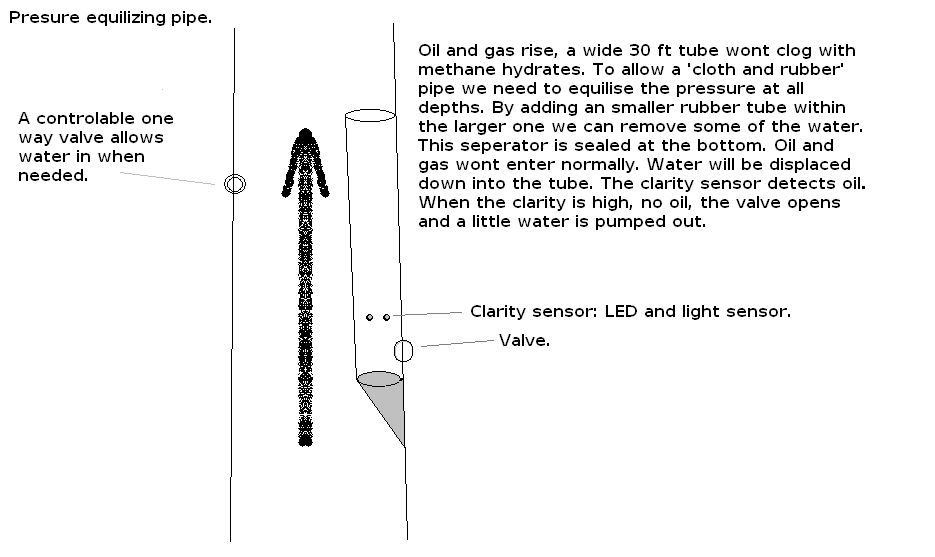
      These bladders can also help separate the oil from the water. By adding pipes to the bottom that hang down several meters and clarity sensors and pumps, water can be drained out the bottom of this contained oil slick. A clarity sensor is a LED and a photo-detector. Oil obstructs this light and the valve shuts, when the water is reasonably clear the valve opens and the small pump runs. Air bubble may assist clarify the water in these pipes.

      The second challenge is pressure on the structure.
      This is why the oil men use steel. The ocean at these depths apply great forces on pressurised  structures. The oil and gas apply forces of their own due to buoyancy, de-pressurising hydrates, chemical reactions with the sea water and drag effects. There is also entrained debris from the sea bed to deal with at the seeps. Allowing water in and out to equalise pressure will allow the structure to deploy. Water can be pumped in to fender the plastic and sacrificial canvas linings may help. Removing some of the water higher up the pipe will also help with the hydrate problem. The key is to control the oil flow not worry about de-watering until we're clear of the hydrates problem. One way valves and water pumps in the lower structure would equalise there. Higher up we would need an oil water separator integral to the wall of the big pipe.
      The oil and gas flow passes this structure; water is displaced downward. The two little dots are more clarity sensors activating the pump/valve.

      Lastly, This structure, particularly the canopy, can be constructed from modular patches of material and put together with a heavy volunteer input. Final assembly and folding is easy with thousands of volunteers hard with hundreds of cranes and complex jugs.
      Deployment should be done with fishing boats and barges and the big tent should be sized for the available vessels. There are several natural oil seeps that this technology may also work on.
       
      Someone needs to rally the necessary materials and resources to get these equi-pressure caps and bladder based contained slicks made and deployed.
      Lets get going on the underwater circus tents; the circus in Washington and London isn't getting us anywhere.